
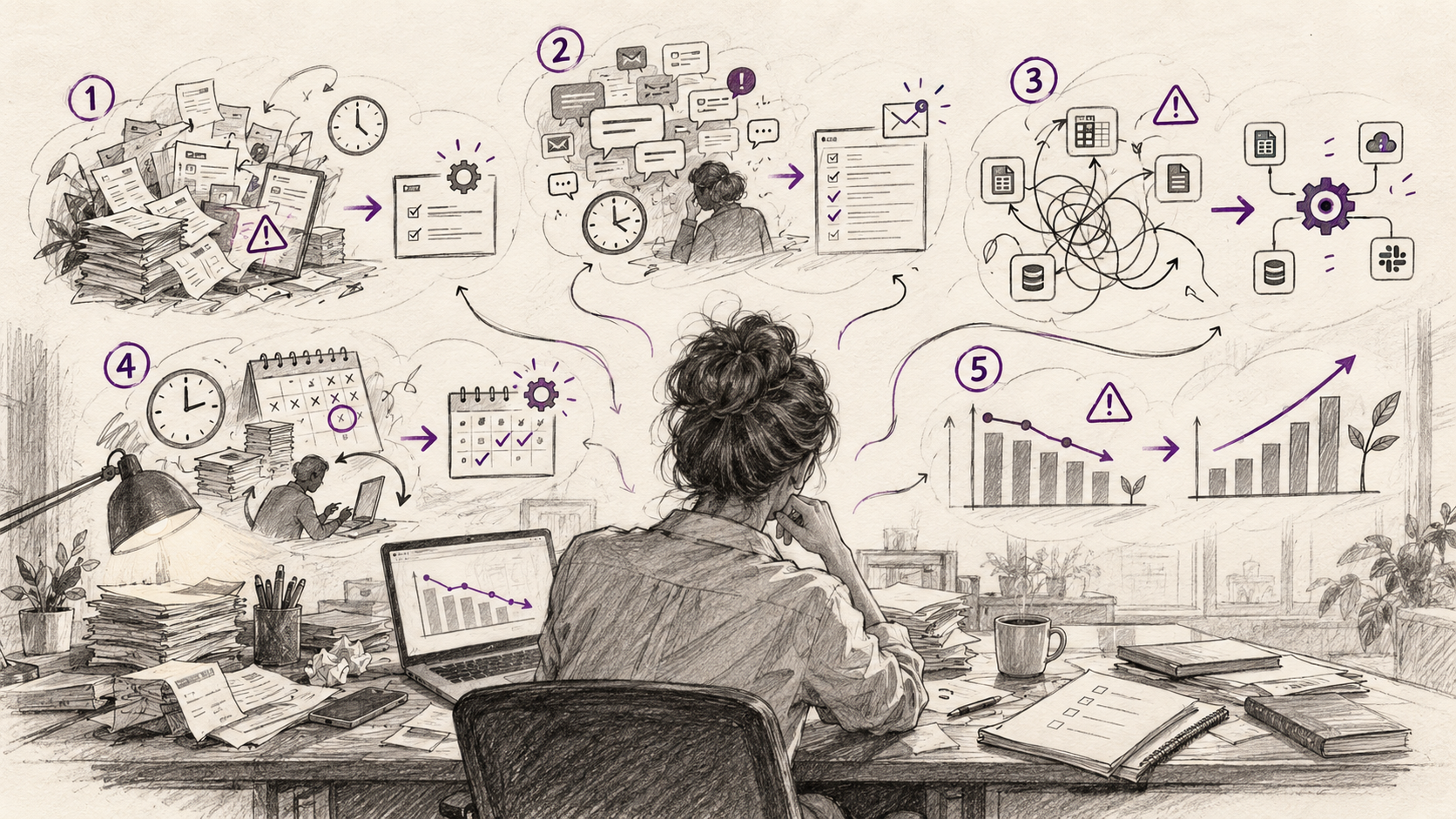
Imagine it is Friday afternoon at 4:30 PM. Your sales manager is calling your warehouse team to find out if a critical order was shipped. Your accountant is manually copying line items from a PDF invoice into your billing software. Meanwhile, your WhatsApp groups are buzzing with messages asking if anyone got around to replying to that major corporate lead from Wednesday.
Your team is exhausted, working ten-hour days, yet your growth has plateaued. You might think you need to hire more people, but more staff won't fix a broken engine. The real culprit is operational friction. Your business processes are leaking time, money, and customer trust.
At Axyva, we help SMBs cut through the operational noise. Here are five undeniable signs that your business processes are ripe for automation, along with the concrete, practical fixes to reclaim your team’s productive hours.
1. Your Team Spends More Time Copying and Pasting Than Doing Actual Work
If your employees’ main daily achievement is moving data from one system to another, you are wasting valuable human intellect. A common example is "double entry": your customer places an order on your website, your admin manually types it into your billing software, and your dispatch manager copies that same address into a courier portal.
Every manual keystroke carries a "typo tax." A single misspelled street name or incorrect product code can lead to returned shipments, angry customers, and hours of damage control.
- The Cost: Lost productivity, high error rates, and disengaged staff who feel like data-entry clerks.
- The Fix: Simple integration pipelines. Instead of manual copying, you can link your order system directly to your shipping and accounting software. Data flows securely and instantly without human intervention.
2. Decisions Grind to a Halt Waiting for "Sign-Off"
Does your business stop moving when you or a key manager goes offline? If a sales rep needs a custom discount approved for a major deal, or a purchasing officer needs a signature for an urgent inventory order, those requests shouldn't sit in an inbox graveyard for two days.
When approvals rely on physical signatures, endless email threads, or casual WhatsApp messages, deals fall through. Modern buyers do not wait; they move to competitors who respond in minutes, not days.
- The Cost: Lost revenue, missed opportunities, and internal bottlenecks.
- The Fix: Rule-based approval workflows. For instance, you can set up a system where any discount request under 10% is automatically approved. Anything above that triggers an instant, interactive notification on the manager’s phone with a simple "Approve" or "Reject" button, updating your CRM in real time.
3. Leads Go Cold Because Someone "Forgot to Follow Up"
Acquiring a new business lead in Pune's competitive market is expensive. Whether you run a coworking space in Baner or an industrial supply business in Chakan, you spend money on marketing to get people to inquire. Yet, if a prospect fills out a contact form on your website and waits 24 hours for a response, they have already called three other options.
If your sales team relies on memory, Excel spreadsheets, or sticky notes to manage follow-ups, hot leads will inevitably slip through the cracks.
- The Cost: Direct waste of marketing spend and lost customer lifetime value.
- The Fix: Automated lead nurturing. The moment a lead is captured, an automated system can instantly send a personalized WhatsApp or email acknowledgment with your brochure or a calendar link. Simultaneously, the system assigns a task to the right salesperson with an automated reminder to call them back within two hours.
4. You Run Your Business on a "Frankenstein" Network of Spreadsheets
We all love Microsoft Excel and Google Sheets. They are fantastic for prototyping a business. But when you are running your daily inventory, customer database, and dispatch tracking across twelve different sheets, you are playing a risky game.
One broken formula or accidental deletion by a team member can throw off your entire inventory count or corrupt your sales data. If you have to open four different files just to figure out your monthly profitability, your systems are telling you they have had enough.
To stop fighting with broken formulas and mismatched sheets, many growing SMBs turn to business process automation to connect their inventory, sales, and accounts into a single, reliable workflow. Transitioning from fragile spreadsheets to secure, connected software is the most significant step you can take to mature your operations.
- The Cost: Inaccurate business data, hours spent "cleaning" reports, and critical business security risks.
- The Fix: Centralized databases with automated data flows. Instead of individual sheets, use connected tools that talk to each other, giving you a single source of truth for your business health.
5. Your Team Spends Half Their Day Answering "What’s the Status?" Calls
If your customer support desk or sales team spends hours every day answering calls like, "Where is my shipment?" or "Has my invoice been processed?", you have a visibility gap.
To answer these questions, your staff must stop what they are doing, call the warehouse, call the logistics partner, or hunt through emails, and then call the customer back. This is a massive drain on payroll and creates a frustrating experience for the customer.
- The Cost: High customer support costs, slow resolution times, and frustrated buyers.
- The Fix: Automated status triggers. Just like modern e-commerce giants, you can set up automated alerts. When an order status changes to "Dispatched" in your system, an automated WhatsApp notification or SMS is instantly sent to the customer with their tracking link.
Real-World Impact: How a Pune Distributor Saved 22 Hours a Week
Consider the case of a mid-sized regional distributor of industrial packaging materials based in Bhosari, Pune. They had a team of eight sales representatives operating across Maharashtra. Every time a client requested a bulk discount, the rep had to draft an email to the business owner, who was often traveling or in client meetings. The average approval took 32 hours, causing them to lose quick-turnaround orders to local competitors.
We helped them implement a simple, automated approval matrix. Standard orders within standard pricing models were auto-approved. Custom pricing requests now trigger an instant notification directly to the owner's WhatsApp. With one tap, the owner approves or rejects the deal, instantly updating the sales rep and generating the invoice.
The result? Average approval times dropped from 32 hours to under 15 minutes. The sales team closed 18% more deals within the first quarter, and the owner reclaimed nearly half a day of work every single week.
Stop Fighting Your Processes and Start Growing
Operational bottlenecks are not just administrative nuisances; they are a direct tax on your profitability and team morale. If you recognized your business in even two of these five signs, it is time to shift from manual fire-fighting to automated growth. You don't need a massive IT budget or complex enterprise software to make your operations seamless. You just need to make your existing software work smarter.
To find out where your business is losing hours and missing revenue, Book a free discovery call to assess AI opportunities with our practical automation experts. Let's make your operations work for you, not the other way around.