Table of Contents

Capturing 5–15% Productivity Gains: A 2026 AI Playbook for SMBs
AI productivity for small business is no longer a future concept: small and mid-sized businesses are already putting AI to work.
The real question in 2026 is simpler and more important: How do you turn AI usage into measurable business results?
That matters because AI adoption has moved into the mainstream. Recent research shows 57% of U.S. small businesses are now investing in AI, up from 36% in 2023. Other studies report that 77% of SMBs use AI regularly, and many plan to increase spending further.
But adoption alone does not guarantee value. Many businesses have employees experimenting with ChatGPT, Microsoft Copilot, or other tools without a clear plan for improving workflows, reducing costs, or increasing output.
That is where the opportunity is.
For most SMBs and mid-market firms, the biggest wins do not come from dramatic transformation overnight. They come from practical workflow improvements that create steady, repeatable efficiency gains. In many cases, that means a realistic 5–15% improvement in productivity—enough to free up capacity, speed up execution, and improve margins.
This guide explains where those gains come from, how to approach AI implementation for small business, and how to measure SMB AI ROI in a way leadership can trust.
Why AI Productivity for Small Business Is a 2026 Priority
AI is no longer a future initiative. It is becoming part of day-to-day operations.
Several 2026 and late-2025 data points make that clear:
- 57% of U.S. small businesses are investing in AI
- 77% of small and midsize businesses now use AI regularly
- 63% of current AI users in small businesses use AI tools daily
- Daily users report saving more than 20 hours per month on average
That is a meaningful shift. Businesses are moving from curiosity to expectation. Leadership teams now want to know:
- Where can AI save time?
- Which workflows should we automate?
- How quickly can we see ROI?
- What tools should we standardize across teams?
This is why AI productivity for small business has become such a high-priority topic. The competitive risk is no longer “falling behind on innovation.” It is running less efficiently than peers who are redesigning work around AI.
At the same time, decision-makers should stay grounded. The most credible research suggests that a well-deployed AI program in an SMB can drive 5–15% productivity gains. That is significant, but it is not magic. Businesses that expect inflated, instant results often end up disappointed. Businesses that focus on process design, training, and measurement usually see better outcomes.
Where AI Productivity for Small Business Gains Come From
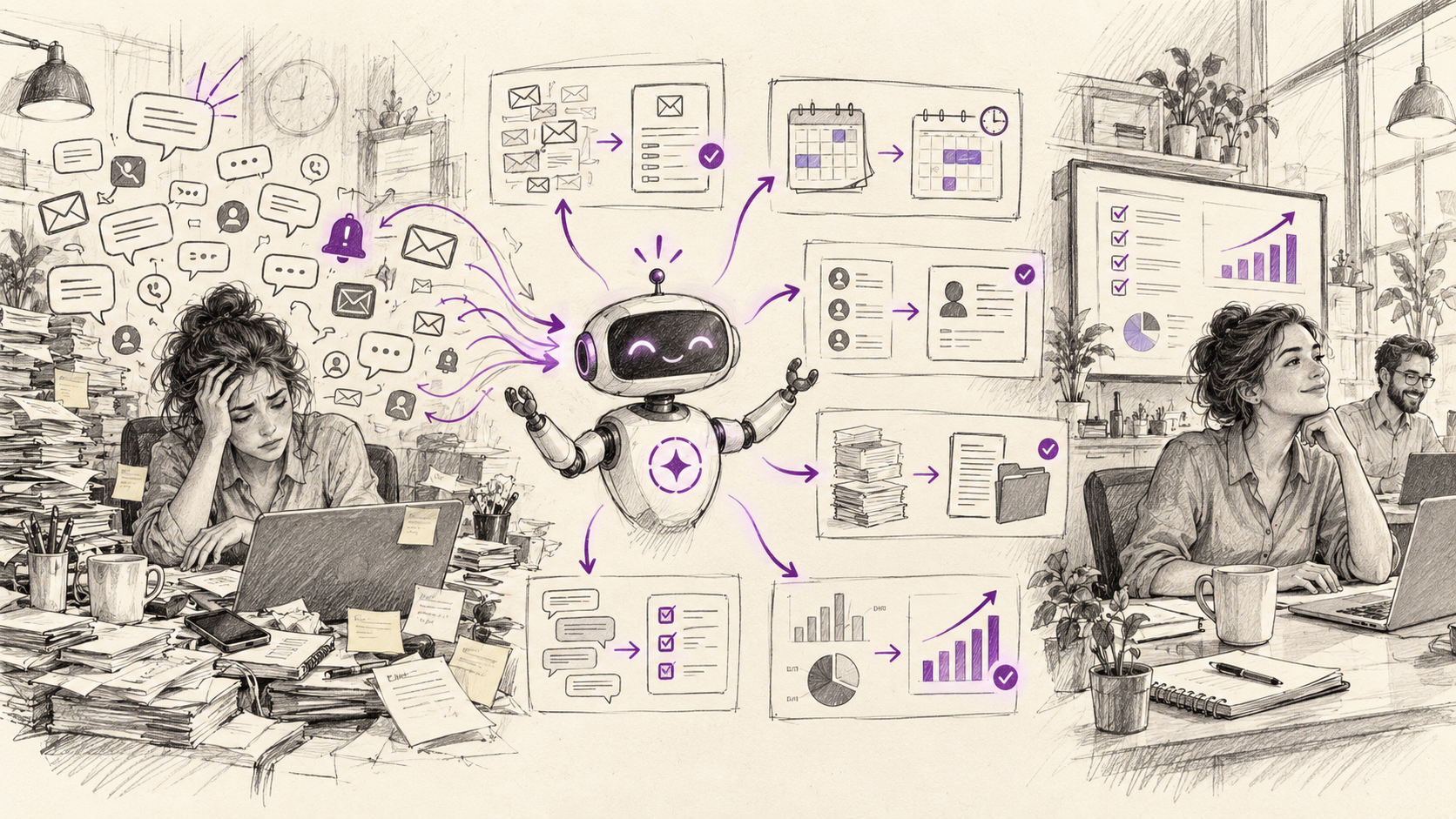
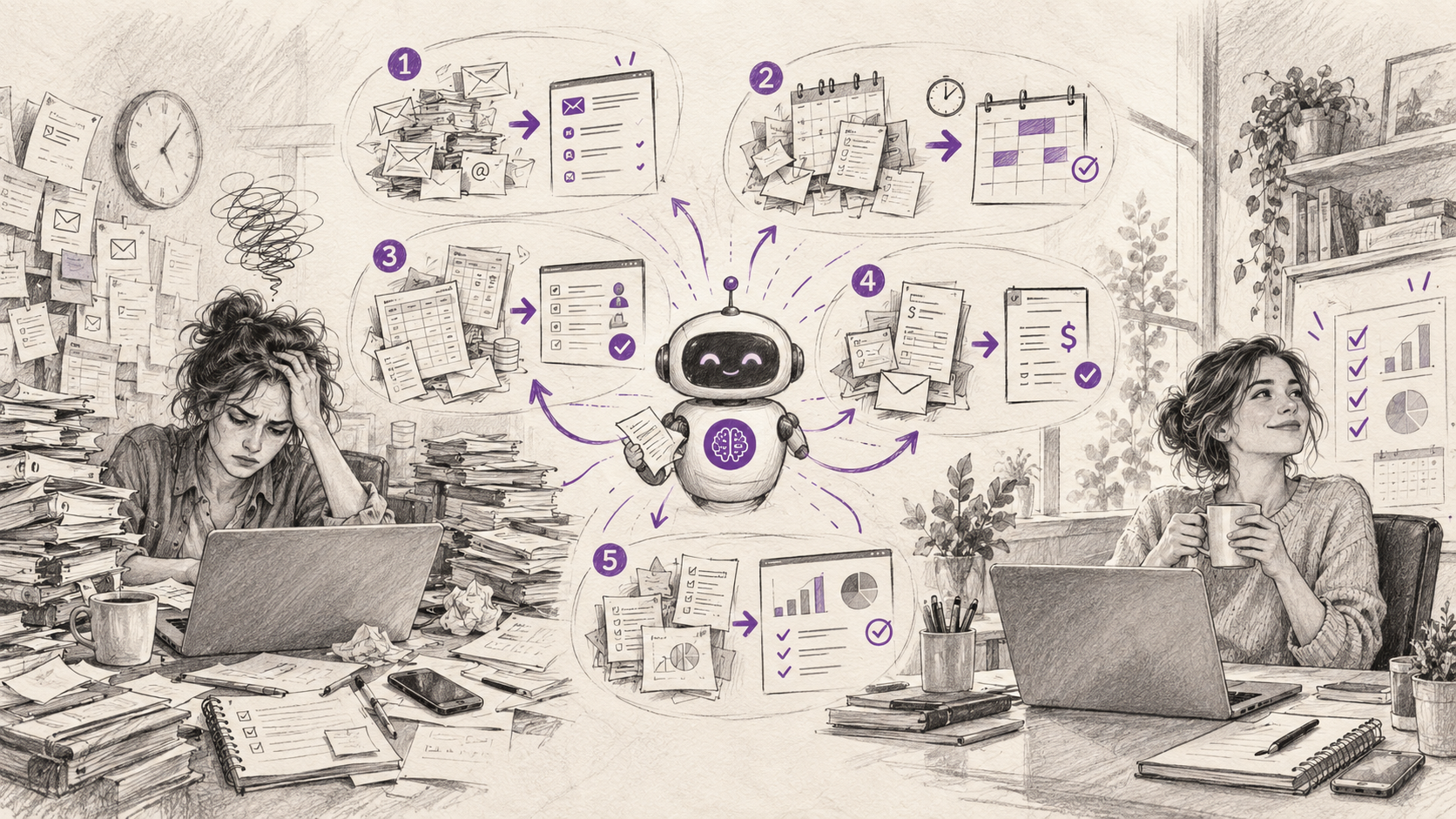
The best opportunities are usually hidden in repetitive, high-volume work.
In most businesses, employees lose time every day to tasks that are necessary but low-value:
- Writing and responding to routine emails
- Creating first drafts of proposals, reports, and documents
- Summarizing meetings and extracting action items
- Updating CRM records after sales calls
- Handling common customer service responses
- Producing internal reports from scattered data
- Managing invoice, finance, or approval workflows
These are ideal areas for AI automation for SMB operations because they happen frequently, involve repeatable steps, and often slow down skilled employees.
Research supports this. One 2026 outlook report found that small business workers using generative AI save an average of 5.6 hours per week, while managers save 7.2 hours per week. That is a meaningful percentage of a standard workweek.
The key is to convert those isolated time savings into operating improvements across the business.
Common high-impact use cases
1. Sales and CRM
AI can:
- Draft follow-up emails after calls
- Summarize meetings automatically
- Update CRM fields based on conversation notes
- Suggest next steps or proposals
Result: sales teams spend more time selling and less time on admin.
2. Customer service
AI can:
- Draft responses to common support requests
- Route tickets based on issue type or urgency
- Surface knowledge base answers for agents
- Power self-service chat for basic inquiries
Result: faster response times, reduced workload, and more consistent service.
3. Finance and operations
AI can:
- Extract information from invoices and forms
- Flag exceptions for human review
- Automate status updates and approvals
- Generate recurring reports
Result: fewer manual steps, lower error rates, and better process visibility.
4. Internal productivity
AI can:
- Summarize meetings and documents
- Draft internal communications
- Create first-pass reports and presentations
- Help onboard employees faster
Result: teams move faster without sacrificing quality.
A Simple 4-Step AI Implementation Playbook for Small Business
The difference between scattered AI usage and measurable gains is a structured rollout. Here is a practical approach.
1. Audit current workflows and existing AI usage
Before buying more tools, understand what is already happening.
Ask questions like:
- Which teams are already using AI informally?
- Which tasks consume the most manual time every week?
- Where are delays, bottlenecks, or repetitive handoffs happening?
- Which processes are high-volume and rules-based?
This step often reveals that employees are already experimenting, but without standards, governance, or visibility into results.
2. Prioritize 5–10 workflows with clear business value
Do not start with the most complex problem. Start where impact is easier to prove.
Good early candidates usually have:
- High frequency
- Clear process steps
- Significant manual effort
- Measurable outcomes
- Low operational risk
Examples include lead follow-up, support ticket triage, reporting, document drafting, and finance admin.
3. Design AI-in-the-loop workflows with KPIs
AI works best when paired with clear human oversight.
Instead of trying to fully replace people, design workflows where AI handles the repetitive first pass and employees review, approve, or refine the output.
Define metrics before launch, such as:
- Time saved per task
- Turnaround time
- Error reduction
- Output per employee
- Customer response speed
- Revenue per rep or team
This is where AI implementation for small business becomes operational rather than experimental.
4. Launch pilots, measure results, and expand
Start with a focused pilot in one department or workflow. Measure the outcome over 30 to 90 days. Then improve the workflow and scale it.
A successful AI rollout is usually iterative, not one big deployment.
The goal is simple: prove value quickly, then expand with confidence.
Why Off-the-Shelf AI Tools Are Only Part of the Answer
Many SMBs start with general-purpose tools like Microsoft 365 Copilot, and that is often the right first step.
These tools can create immediate value by helping employees write, summarize, search, and organize information faster. Research on Microsoft Copilot ROI for SMBs is especially notable. A Forrester Total Economic Impact study found that SMBs deploying Microsoft 365 Copilot achieved estimated ROI ranging from 132% to 353%, with reported benefits including:
- Up to 6% greater net revenue
- 20% lower operating costs
- 25% faster onboarding
Those are strong signals that structured deployment works.
But off-the-shelf tools have limits. They are useful for general productivity, yet they usually do not solve business-specific workflow challenges on their own.
That is where custom AI agents and intelligent automations create deeper value.
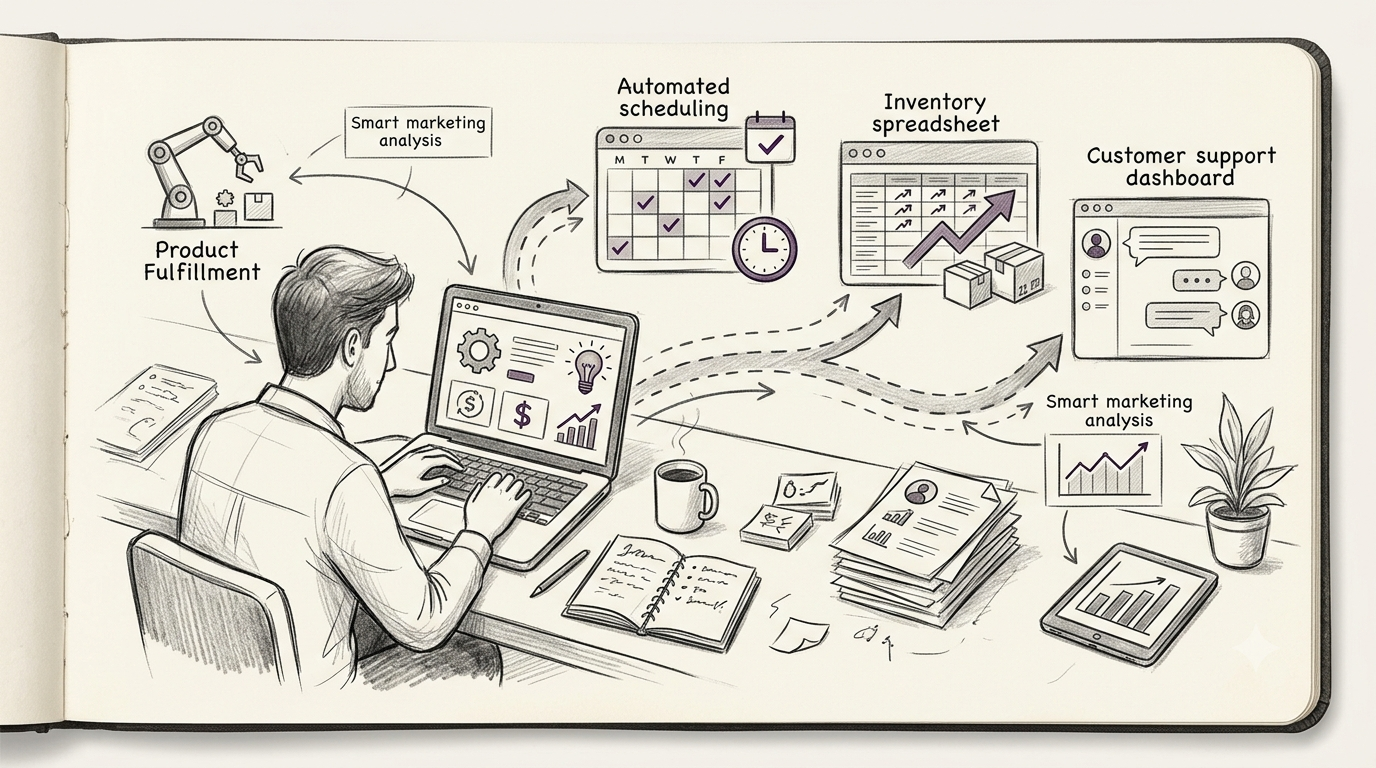
For example, a business might use:
- Copilot or similar tools for drafting, summarizing, and employee productivity
- Custom AI agents to handle inbound lead qualification, customer support triage, or internal knowledge retrieval
- Intelligent automations to move data between systems, trigger follow-ups, or streamline approvals
This combination is often the fastest route to stronger SMB AI ROI: standard tools for broad adoption, custom solutions for the processes that matter most.
How to Measure AI ROI Without Overcomplicating It
Leadership does not need a complicated framework. They need a simple scorecard tied to business outcomes.
Track AI value in four categories:
1. Time saved
Measure hours reduced per employee, per task, or per process.
2. Cost reduction
Look at lower labor effort, reduced rework, and improved operating efficiency.
3. Revenue impact
Measure improvements such as faster lead response, higher conversion, better upsell activity, or increased capacity.
4. Quality and consistency
Track reduced errors, faster turnaround times, improved compliance, or better customer experience.
A straightforward ROI scorecard might include:
- Hours saved per month
- Cost savings per quarter
- Process cycle-time reduction
- Output increase per team
- Revenue influenced by AI-assisted workflows
- Adoption rate by department
This matters because AI success is not just about buying the tool. It is about whether teams use it consistently and whether the business can show measurable gains.
What Business Leaders Should Do Next
If your business is already using AI, now is the time to make that usage more intentional.
Start with three practical actions:
- Identify the workflows where employees lose the most time
- Standardize how AI is used in those processes
- Measure results before expanding further
The companies seeing the best results in 2026 are not necessarily the ones using the most AI tools. They are the ones deploying AI with clear priorities, sound workflow design, and measurable business goals.
That is how AI becomes a real productivity lever instead of another software expense.
Final Thought
The opportunity for AI productivity for small business is real, but the payoff comes from execution. For SMBs and mid-market firms, a 5–15% productivity gain can translate into better margins, faster service, stronger team output, and more room to grow without adding unnecessary overhead.
If you want to move from ad-hoc AI usage to practical implementation, Axyva helps businesses identify the right opportunities, design fit-for-purpose AI agents and automations, and deploy solutions that deliver measurable value.
If that is your next step, it may be worth exploring what a focused AI implementation roadmap could look like for your business.
To improve AI productivity for small business, begin with workflows that are frequent, measurable, and easy to pilot. Sustainable AI productivity for small business comes from pairing the right tools with process design. Explore Axyva's AI agent services and business process automation services, and see Microsoft's business AI productivity guidance.