
Artificial intelligence is everywhere. Businesses are hearing about AI agents, automation, predictive analytics, intelligent assistants, and countless new tools entering the market every month.
The challenge is not finding AI solutions. The challenge is determining where AI can create meaningful value within your organization.
Many businesses approach AI by starting with technology. They explore tools, attend demonstrations, and evaluate platforms before fully understanding the problems they are trying to solve. This often leads to disappointing results, unnecessary complexity, and investments that fail to generate measurable outcomes.
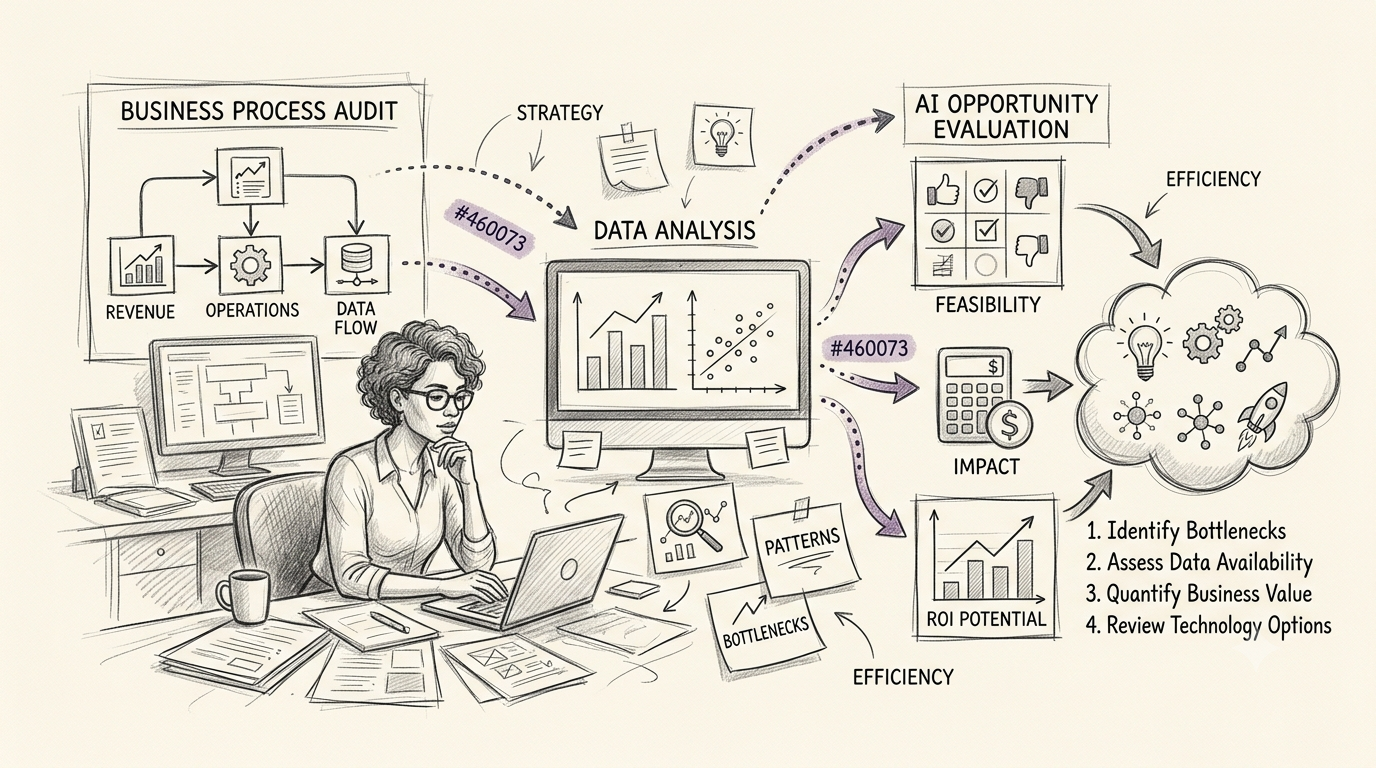
The most successful AI initiatives start with business challenges, not technology.
If your organization is exploring AI, here is a practical framework for identifying opportunities that can deliver real business value.
Start with business objectives
Before evaluating any AI solution, it is important to understand what the business is trying to achieve.
Every organization has goals related to growth, efficiency, customer experience, profitability, or operational performance. AI should support these objectives rather than exist as a standalone initiative.
Ask questions such as:
- What business challenges are limiting growth?
- Where are teams spending excessive time?
- Which processes create delays or bottlenecks?
- What activities generate the highest operational costs?
- Where do customers experience friction?
The answers often reveal the areas where AI can provide the greatest impact.
Look for repetitive work
One of the easiest ways to identify AI opportunities is to examine repetitive activities performed by employees.
Many teams spend hours every week completing tasks that follow predictable patterns. Examples include responding to common questions, processing information, generating reports, updating records, and routing requests.
These activities consume valuable time but rarely require deep strategic thinking.
AI can often assist with or automate these processes, allowing employees to focus on higher-value responsibilities.
Departments such as customer support, sales, operations, human resources, and administration frequently contain opportunities for immediate improvement.
Analyze customer interactions
Customer-facing processes often provide some of the strongest AI opportunities.
Customers expect fast responses, accurate information, and consistent service across multiple communication channels. At the same time, businesses struggle to keep pace with growing inquiry volumes.
Review how customers currently interact with your organization.
Common opportunities include:
- Answering frequently asked questions
- Lead qualification and routing
- Appointment scheduling
- Customer onboarding
- Product recommendations
- Support request handling
AI agents can often manage these interactions while improving response times and customer satisfaction.
Identify operational bottlenecks
Every organization has processes that slow down work.
These bottlenecks may involve approvals, information gathering, document management, reporting, or communication between departments.
When employees must manually move information between systems or wait for routine decisions, productivity suffers.
AI and automation can help streamline these workflows by reducing manual effort, accelerating decision-making, and improving visibility across operations.
The goal is not necessarily to eliminate human involvement but to remove unnecessary friction.
Examine data and reporting processes
Many organizations collect large amounts of data but struggle to transform it into actionable insights.
Managers often spend significant time gathering information from spreadsheets, reports, dashboards, and multiple business systems before making decisions.
This creates opportunities for AI-powered analytics and business intelligence solutions.
AI can assist by:
- Summarizing complex information
- Identifying trends and anomalies
- Generating reports automatically
- Answering business questions
- Supporting decision-making processes
Organizations that improve access to information often gain advantages in speed, efficiency, and strategic planning.
Prioritize high-impact opportunities
Not every AI idea should become a project.
After identifying potential opportunities, evaluate them based on two factors:
Business impact
How much value could the initiative create?
Consider factors such as:
- Cost reduction
- Time savings
- Revenue growth
- Customer satisfaction
- Productivity improvements
Implementation complexity
How difficult will it be to deploy?
Consider:
- Existing systems
- Data availability
- Technical requirements
- Process complexity
- Organizational readiness
The most attractive opportunities often combine high business impact with relatively low implementation complexity.
These projects can generate quick wins and build confidence for future initiatives.
Avoid common mistakes
Organizations frequently encounter challenges when exploring AI.
Some of the most common mistakes include:
Starting with technology
Businesses sometimes purchase tools before defining objectives.
Without a clear business case, even powerful AI solutions can fail to deliver value.
Trying to solve everything at once
Large-scale transformation projects can become difficult to manage.
A phased approach often produces better results and allows teams to learn as they go.
Ignoring existing processes
Poor processes rarely improve simply because AI is introduced.
Businesses should first understand and optimize workflows before automating them.
Focusing on trends instead of outcomes
AI should solve business problems, not simply demonstrate innovation.
Every initiative should be connected to measurable objectives and expected results.
Build an AI opportunity roadmap
Once opportunities have been identified and prioritized, the next step is creating a roadmap.
An effective roadmap helps organizations:
- Define priorities
- Allocate resources
- Establish timelines
- Measure success
- Reduce implementation risk
Rather than launching disconnected AI projects, businesses can follow a structured plan that aligns with long-term objectives.
This approach creates a stronger foundation for sustainable adoption and future growth.
The role of AI strategy and consultancy
Many organizations understand that AI has potential but lack clarity on where to begin.
This is where strategic guidance becomes valuable.
An experienced AI consultancy can help evaluate business processes, identify opportunities, assess readiness, prioritize initiatives, and develop a practical implementation roadmap.
Instead of relying on assumptions or vendor promises, businesses gain a structured framework for making informed decisions.
Final thoughts
Artificial intelligence can create significant business value, but only when applied to the right challenges.
The most successful organizations focus on solving real operational problems, improving customer experiences, and supporting business objectives rather than adopting technology for its own sake.
By identifying repetitive work, operational bottlenecks, customer service opportunities, and data-driven decision processes, businesses can uncover practical use cases that deliver measurable outcomes.
At Axyva, we help organizations evaluate AI opportunities, develop implementation strategies, and create practical roadmaps that align technology investments with business goals. The result is a clearer path to adoption, lower risk, and greater long-term value from AI initiatives.