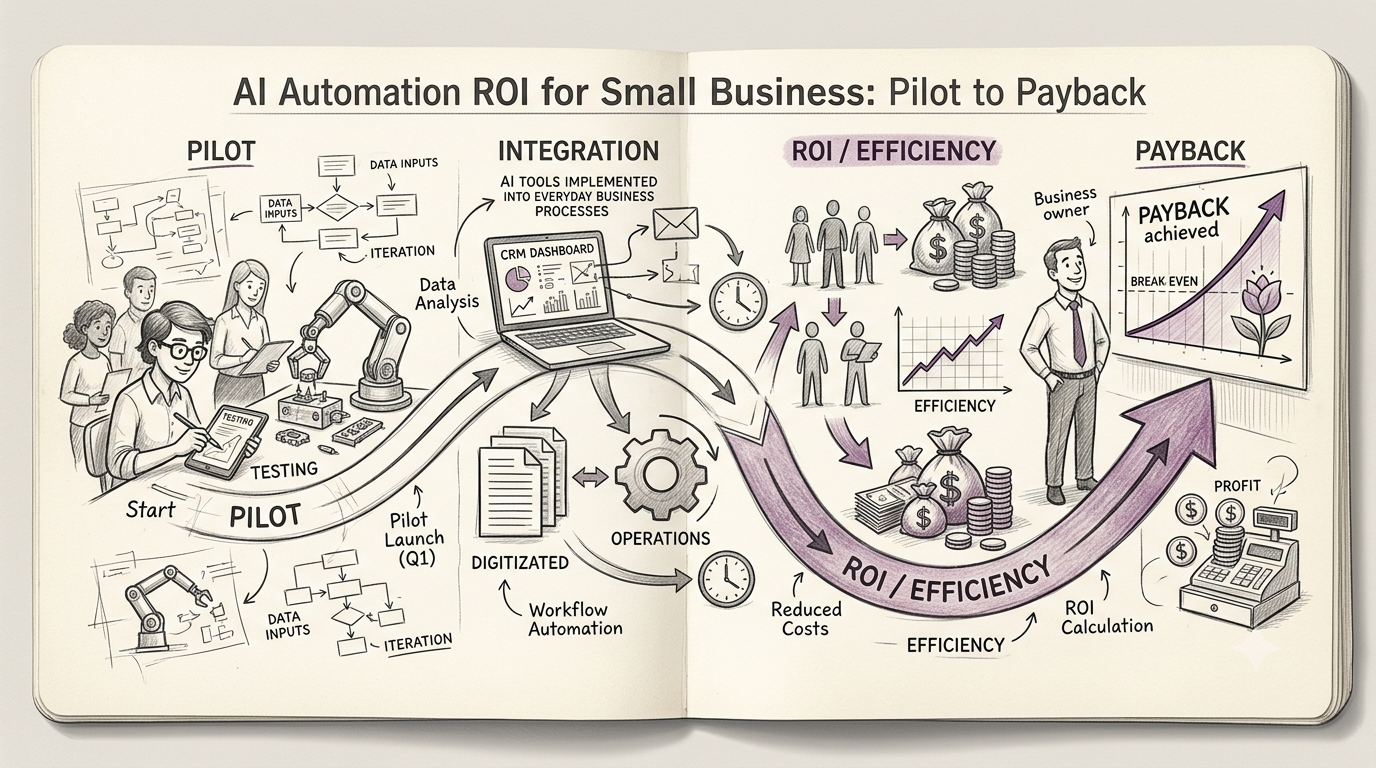
From Pilot to Payback: How SMBs Are Achieving 250%+ ROI From Practical AI Automation in Under 6 Months
For many small and mid-sized businesses, AI has moved past the experimentation stage. The real question is no longer whether to use AI. It is whether you can apply it in a way that improves operations, saves time, and delivers measurable returns quickly.
That matters because business leaders are under pressure to do more with the same team, protect margins, and find practical ways to increase productivity. The good news: recent results show that AI automation ROI for small business is not just possible—it can be substantial when companies focus on the right workflows.
Across recent SMB AI automation projects, businesses are reporting first-year ROI figures in the 250% to 340% range, with payback often arriving in just 2 to 5 months. In many cases, the gains come from straightforward use cases: customer support, lead follow-up, invoicing, reporting, scheduling, and data processing.
The key lesson is simple. AI works best as a disciplined business investment, not a vague innovation initiative.
What realistic AI ROI looks like for SMBs today
There is a lot of noise around AI. Business decision-makers need a more grounded view.
Current SMB-focused data points paint a clear picture:
- AI adoption among small businesses has risen sharply, with many owners saying AI is helping improve business performance.
- Among businesses already using AI, a large majority report a positive impact.
- Efficiency and productivity remain the most common benefits.
- Average AI automation returns are often cited around $3.70 for every $1 invested.
- Median first-year ROI in some SMB automation datasets has reached 340%, with a 4.2-month payback period.
- Many companies also report recovering around 12 hours of staff time per week.
That does not mean every AI project will produce those exact results. A more conservative expectation is still strong: roughly 250% ROI within 18 months for well-scoped automation tied to clear business outcomes.
For non-technical leaders, the takeaway is this: AI can deliver meaningful returns, but the results usually come from targeted workflow improvements, not company-wide rollouts with no defined success metrics.
Where SMBs are getting the fastest payback
The best AI projects usually automate work that is either:
- Labor-heavy and repetitive, or
- Closely tied to revenue capture, customer response time, or cash flow.
These are some of the highest-impact areas for AI workflow automation for mid-market companies and growing SMBs:
1. Customer service and support
This is one of the strongest use cases for AI customer service automation ROI. AI agents can handle common inquiries, route tickets, summarize conversations, and support human teams with draft responses.
Why it pays back quickly:
- Lower ticket handling time
- Faster response times
- Fewer repetitive support tasks
- Better coverage outside business hours
2. Lead qualification and follow-up
AI can score inbound leads, trigger personalized responses, update the CRM, and ensure follow-up happens consistently.
Why it matters:
- Reduces lead leakage
- Improves speed-to-contact
- Helps sales teams spend time on better opportunities
3. Data entry and document processing
Invoices, forms, customer records, PDFs, and internal documents often consume hours of admin time every week.
AI can extract, classify, validate, and route information automatically.
4. Invoice processing and collections
Automating invoice handling, reminders, and approvals can improve cash flow and reduce delays.
This is especially valuable for companies with growing transaction volume and lean finance teams.
5. Reporting and internal summaries
Leaders often wait too long for updates because reporting depends on manual data gathering. AI can generate recurring summaries, consolidate operational data, and highlight exceptions faster.
6. Scheduling and coordination
AI can reduce the back-and-forth involved in meetings, service appointments, onboarding steps, and internal approvals.
7. Email marketing and campaign operations
AI can help create campaign drafts, segment audiences, personalize messaging, and automate follow-up sequences.
In practice, these workflows often reach a favorable AI payback period for small business automation because the savings are visible, measurable, and immediate.
A simple framework to calculate AI ROI before you build
Before investing, leaders should use a basic AI ROI calculator for SMBs approach. You do not need a technical background to do this.
Use this formula:
ROI = ((Annual Benefits - Annual Costs) / Annual Costs) x 100
Step 1: Estimate annual benefits
Start with measurable business impact, such as:
- Hours saved: How much employee time will be reduced each week?
- Error reduction: Will fewer mistakes lower rework or compliance risk?
- Faster revenue capture: Will lead response or quoting speed improve conversions?
- Faster collections: Will invoicing or reminders improve cash flow?
- Capacity gains: Can the existing team handle more volume without new hires?
For example, if automation saves 10 hours per week and those hours are worth $35 each, that equals more than $18,000 per year in recovered capacity.
Step 2: Estimate annual costs
Typical SMB cost ranges include:
- $50 to $500 per month for simpler AI tools or subscriptions
- $5,000 to $30,000+ for custom workflows, AI agents, and integrated automations
The right investment depends on process complexity, system integrations, and the level of customization required.
Step 3: Set a payback target
A good rule of thumb: if a proposed automation is unlikely to pay back within 3 to 6 months, it may not be the best first project.
That is especially true for SMBs that want low-risk wins before expanding further.
What successful AI implementation looks like in practice
The companies seeing the strongest results are usually not doing more AI. They are doing better-scoped AI.
Common patterns include:
They start with one high-friction workflow
Instead of trying to transform the whole business, they focus on a process that already causes delays, costs money, or limits growth.
Examples:
- A support team buried in repetitive tickets
- A sales team missing follow-up windows
- A finance team spending hours processing invoices
- An operations team manually compiling weekly reports
They redesign the workflow, not just the task
This matters. Replacing one manual step with AI is useful, but true ROI usually comes from improving the full workflow end to end.
For example, better lead automation is not just writing an email. It includes:
- Capturing the lead
- Scoring it
- Routing it correctly
- Triggering follow-up
- Logging activity in the CRM
- Alerting the team when action is needed
They track business outcomes from day one
Strong AI programs measure impact with specific KPIs such as:
- Time saved per process
- Cost per task
- Response time
- Conversion rate
- Invoice turnaround time
- Tickets resolved per employee
- Revenue influenced by automation
This is how companies connect automation to ROI, not just activity.
Why some AI projects fail to show productivity gains
Not every AI tool automatically improves performance.
That is clear from mixed results around AI assistants such as Copilot. Some studies show meaningful savings—often 2.5 to 5 hours per employee per week and potential ROI above 100%. Others found no clear productivity gains in certain environments because employees had to spend extra time reviewing, correcting, or verifying outputs.
The lesson for business leaders is important: implementation quality matters as much as the technology itself.
Here are the most common reasons AI projects underperform:
- No clear business case
- Poor workflow design
- Too much manual verification
- Weak adoption by staff
- No KPI tracking
- Trying to automate low-value tasks first
How to improve your odds of fast ROI
If you want practical AI productivity gains for SMB owners, focus on these principles:
Start with a measurable pain point
Pick a process that is repetitive, expensive, slow, or tied directly to customer experience or revenue.
Keep the first use case narrow
A focused pilot reduces risk and makes it easier to prove value quickly.
Prioritize integration and ownership
AI should fit into how your team already works. Someone inside the business also needs ownership for outcomes, adoption, and measurement.
Design for human oversight where needed
The goal is not to remove people from important decisions. It is to remove avoidable manual work while keeping quality high.
Expand only after the first win
Once one automation proves itself, you can scale confidently into other workflows.
From experimentation to measurable business value
AI is becoming a practical operating advantage for SMBs and mid-market businesses—but only when it is applied with discipline.
The strongest returns are not coming from flashy pilots. They are coming from well-chosen automations that reduce admin work, improve response times, support better customer experiences, and help teams handle more without adding unnecessary overhead.
If you are evaluating AI, the right question is not “Where can we use AI?” It is “Which workflows can produce clear business value in the next 3 to 6 months?”
That is where a structured implementation approach makes the difference.
At Axyva, we help businesses identify the right opportunities, prioritize high-ROI workflows, and deploy custom AI agents and intelligent automations that solve real operational problems. If you are ready to move from pilot to payback, it may be time to explore what a practical AI roadmap could look like for your business.