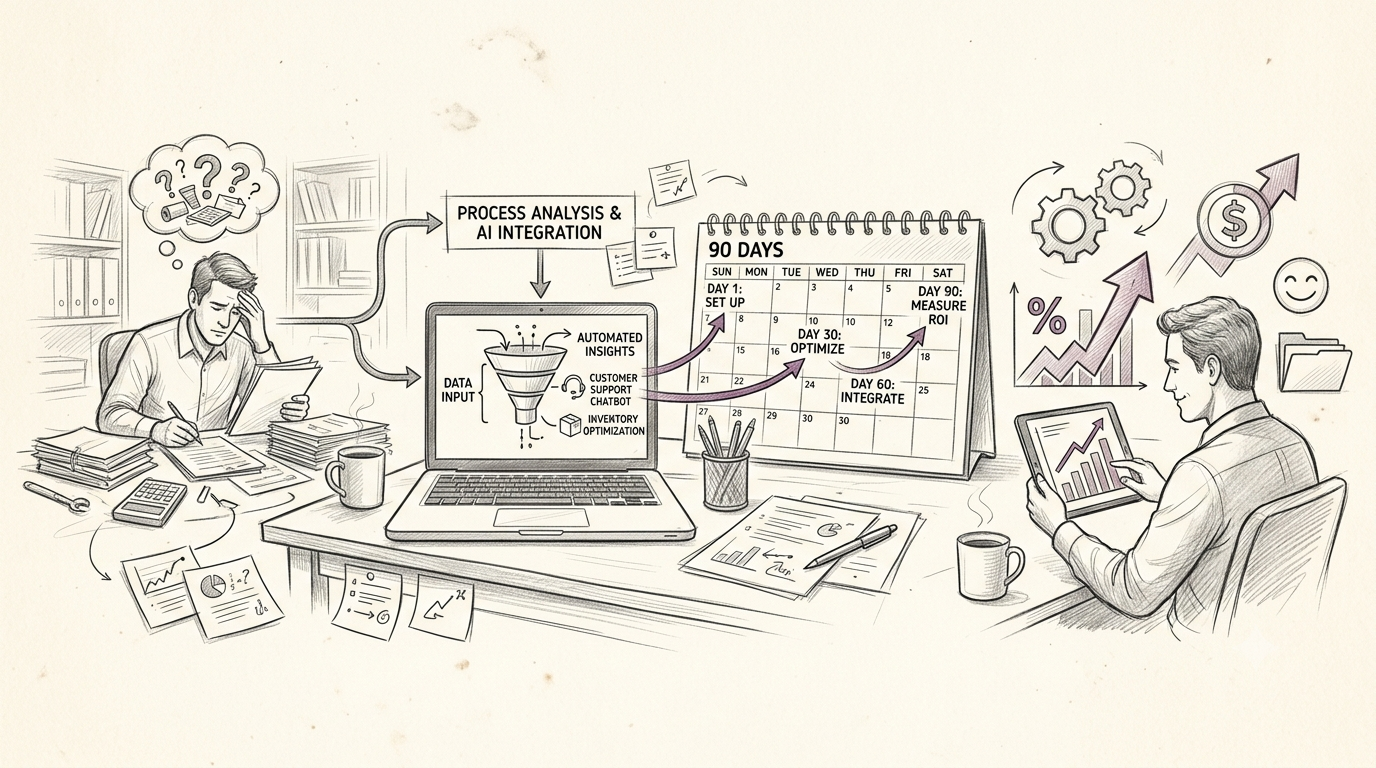
From AI Features to Real ROI: A 90-Day Plan for SMBs
Many SMBs and mid-market companies are already paying for AI.
It is built into Microsoft 365, CRM platforms, customer support tools, marketing software, and workflow apps. The problem is not access. The problem is results.
Business leaders are asking the right question: How do we turn AI features and simple automations into measurable business value?
That is where many companies get stuck. AI adoption is rising fast, but strategy is lagging behind. Recent data shows that about 58% of small businesses used generative AI in 2025, and many more use AI indirectly through software they already own. Yet only a small minority have a formal AI plan, clear ownership, or a practical way to measure success.
If you want better AI automation ROI for small business operations, the answer is not to chase more tools. It is to start with the right workflows, measure the right outcomes, and build around real business friction.
Here is how to do it in 90 days.
The Current AI Reality for SMBs: High Adoption, Low Strategy
AI is no longer an enterprise-only conversation.
Small and mid-sized businesses are using AI to write emails, summarize meetings, automate repetitive tasks, improve customer response times, and help teams work faster. Research shows:
- Around 65% of organizations now use generative AI in at least one business function
- Roughly 42% of SMBs use AI in at least one business process
- About 74% of SMBs use AI through embedded features in existing software
- The average SMB spends roughly $18,000 per year on AI-related tools and subscriptions
- Only around 12% have a dedicated AI strategy
This gap matters.
Without a strategy, businesses often end up with scattered AI subscriptions, inconsistent adoption, and no reliable way to tell what is working. That leads to wasted spend, missed opportunities, and skepticism from leadership.
The good news is that you do not need a massive transformation program to create value. Many of the best AI automation case studies SMB leaders care about start with focused improvements in everyday workflows.
Where AI Automation Pays Off First
For most businesses, the fastest returns come from routine, high-volume processes that slow teams down.
Here are the best places to start.
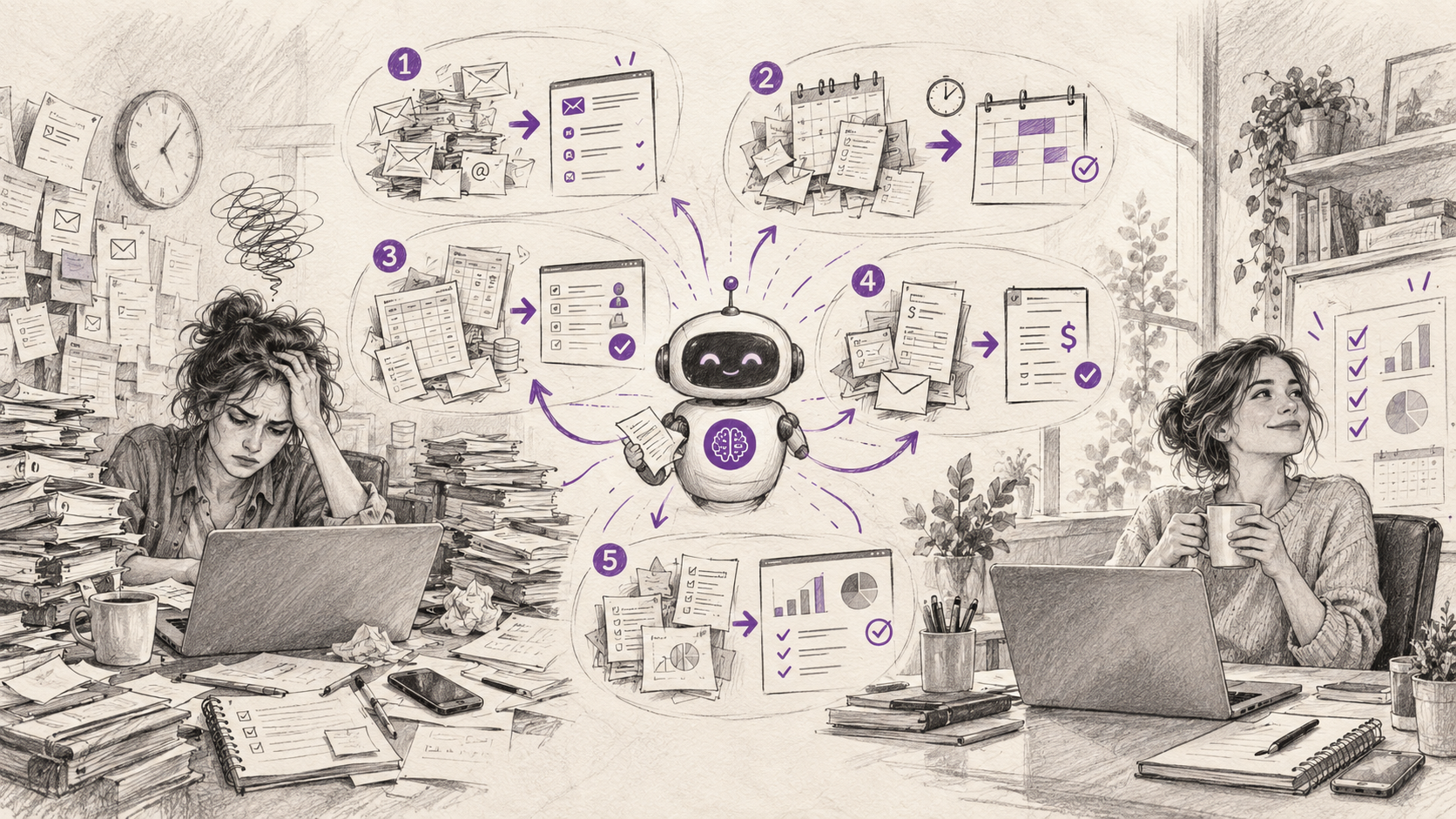
1. Customer Service Triage
AI can review incoming support requests, categorize them, suggest responses, and route them to the right person.
Business impact:
- Lower cost per ticket
- Faster first response times
- Better customer experience
- Less manual sorting for your team
This is one of the most practical examples of AI business process automation for mid-market companies because it reduces operational drag without changing your entire support model.
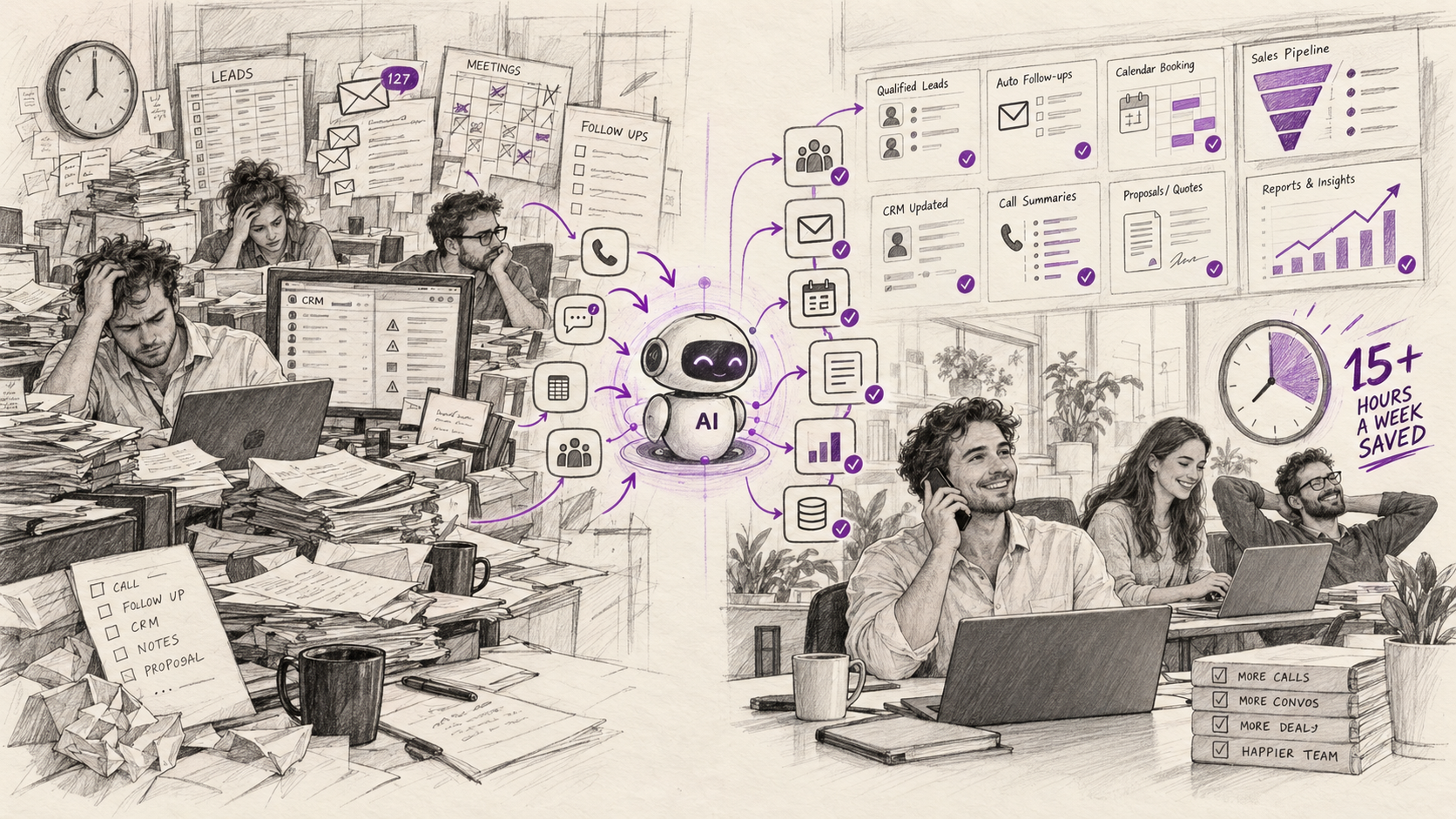
2. Lead Qualification and Sales Follow-Up
AI agents can score inbound leads, summarize prospect activity, draft follow-up emails, and trigger the next action in your CRM.
Business impact:
- Faster response to inbound leads
- More consistent follow-up
- Higher conversion rates
- More selling time for reps
Instead of asking sales teams to do more admin work, AI helps them focus on conversations that generate revenue.
3. Reporting and Internal Updates
Teams spend hours every week pulling data, summarizing performance, and preparing status updates. AI can automate recurring reports, generate summaries, and flag key changes.
Business impact:
- Hours saved each week
- Faster access to insights
- Better decision-making
- Less spreadsheet work
This is often one of the easiest wins because the process is already structured.
4. Document and Approval Workflows
Contracts, onboarding forms, invoices, policy documents, and internal requests often create avoidable delays. AI can extract information, route documents, check for missing details, and draft standard responses.
Business impact:
- Shorter cycle times
- Fewer errors
- Faster approvals
- Lower administrative overhead
5. Employee Productivity in Everyday Tools
Many businesses are already exploring Microsoft 365 Copilot ROI for SMBs because teams live inside email, documents, spreadsheets, and meetings every day.
Research on Copilot-style assistants points to strong results, including:
- Up to 353% ROI in some SMB studies
- Around 6% increase in net revenue
- About 20% reduction in operating costs
- Faster onboarding for new hires
The key point is simple: productivity gains add up quickly when they happen across the tools your team already uses.
A Simple 90-Day Roadmap to Measurable ROI
If you are wondering how to measure AI ROI in small business settings, start with a controlled rollout instead of a company-wide push.
Days 0-30: Audit What You Already Have
Before buying anything new, look at the software stack you already pay for.
Ask:
- Which tools already include AI features?
- Which teams are using them today?
- Where are the biggest workflow bottlenecks?
- Which tasks are repetitive, manual, and high-volume?
Then choose 2 to 3 workflows with clear friction and visible business impact.
Good selection criteria:
- High time cost
- Repetitive steps
- Existing process owners
- Easy-to-track outcomes
At this stage, define success metrics before launching anything.
Days 31-60: Launch Focused Pilots
Now implement lightweight automations or AI agents around the selected workflows.
Examples:
- AI-based ticket routing in customer support
- Automated lead qualification and follow-up prompts in sales
- Weekly reporting summaries for operations or finance
- Document extraction and routing for back-office teams
Keep the scope narrow. The goal is not innovation theater. The goal is measurable value.
Track baseline performance against pilot performance using business KPIs such as:
- Hours saved
- Cycle time reduction
- Cost per task or ticket
- Error reduction
- Lead conversion rate
- Revenue per employee or rep
Days 61-90: Review, Expand, and Standardize
At the end of the pilot period, compare outcomes against your original targets.
Decide what falls into these three categories:
- Scale it: Strong ROI, clear adoption, measurable impact
- Fix it: Good potential, but poor process design or adoption issues
- Stop it: Low value, weak adoption, or unclear business case
This is also the point to establish simple governance:
- Assign an owner for each AI-enabled workflow
- Create a basic review cadence
- Document approved tools and use cases
- Sunset redundant or low-value AI subscriptions
This step is where AI moves from experimentation to operating discipline.
How to Quantify AI ROI Without Overcomplicating It
A lot of leaders overthink measurement. You do not need a complex analytics program to evaluate ROI.
Start with a simple formula:
ROI = (Value created - Total cost) / Total cost
Then focus on a few practical inputs.
Measure Time Saved
Estimate hours saved per employee or team per week.
Research suggests SMB AI deployments can recover about 12 hours of staff time per week in successful automation projects, while broader adoption studies report around 114 hours saved per employee per year.
Measure Cost Reduction
Track changes in:
- Administrative workload
- Overtime
- Support handling costs
- Rework caused by errors
- Vendor or software overlap
Measure Revenue Impact
For customer-facing workflows, measure:
- Faster lead response time
- Higher close rates
- Improved retention
- Increased output per rep
Measure Payback Period
This is especially useful for decision-makers.
Recent AI automation case studies SMB data shows a median first-year ROI of around 340% and a median payback period of 4.2 months. That gives leadership teams a realistic benchmark for what a well-designed pilot can deliver.
Use a Simple Dashboard
A practical AI dashboard for leadership might include:
- Hours saved this month
- Cost savings this quarter
- Revenue impact by workflow
- Adoption rate by team
- Payback period by automation
The goal is clarity, not complexity.
Common Pitfalls That Hurt ROI
Most poor outcomes do not come from the technology itself. They come from avoidable execution mistakes.
Pitfall 1: Chasing Tools Instead of Problems
Buying AI software without a clear business case usually leads to weak adoption.
Better approach: Start with a process problem, then choose the simplest AI solution that fits.
Pitfall 2: No Clear Ownership
If nobody owns the workflow, nobody owns the result.
Better approach: Assign one sponsor per process and make success measurable.
Pitfall 3: Ignoring Embedded AI You Already Pay For
Many businesses underuse AI features inside their existing platforms.
Better approach: Audit current tools first. The fastest ROI often comes from what is already in your stack.
Pitfall 4: Measuring Activity Instead of Outcomes
Usage is not the same as value.
Better approach: Track hours saved, cycle time, cost reduction, and revenue impact.
Pitfall 5: Trying to Scale Too Early
Company-wide AI rollouts create complexity before the business case is proven.
Better approach: Pilot, measure, refine, then expand.
What Smart SMB Leaders Should Do Next
The opportunity is real, but so is the risk of wasting time and budget on scattered experiments.
The companies seeing the best returns are not necessarily the ones using the most advanced AI. They are the ones applying AI with discipline to practical workflows that matter.
If your business wants better AI automation ROI for small business operations, the next step is straightforward:
- Audit the AI already in your tools
- Identify 2 to 3 high-friction workflows
- Launch focused pilots with clear KPIs
- Measure results over 90 days
- Expand only what proves its value
That is how AI becomes a business asset instead of another software expense.
At Axyva, we help SMBs and mid-market companies identify the right AI opportunities, design practical automations and AI agents, and deploy solutions that deliver measurable business value. If you want a clear path from AI interest to ROI, it may be time to explore what a focused AI implementation plan could look like for your business.