From Experiments to ROI: How SMBs Can Turn AI Pilots into Measurable Productivity Gains in 90 Days
AI has moved past the novelty stage for small and mid-sized businesses. The real question is no longer whether AI matters. It is whether your business can turn AI experiments into clear operational and financial results.
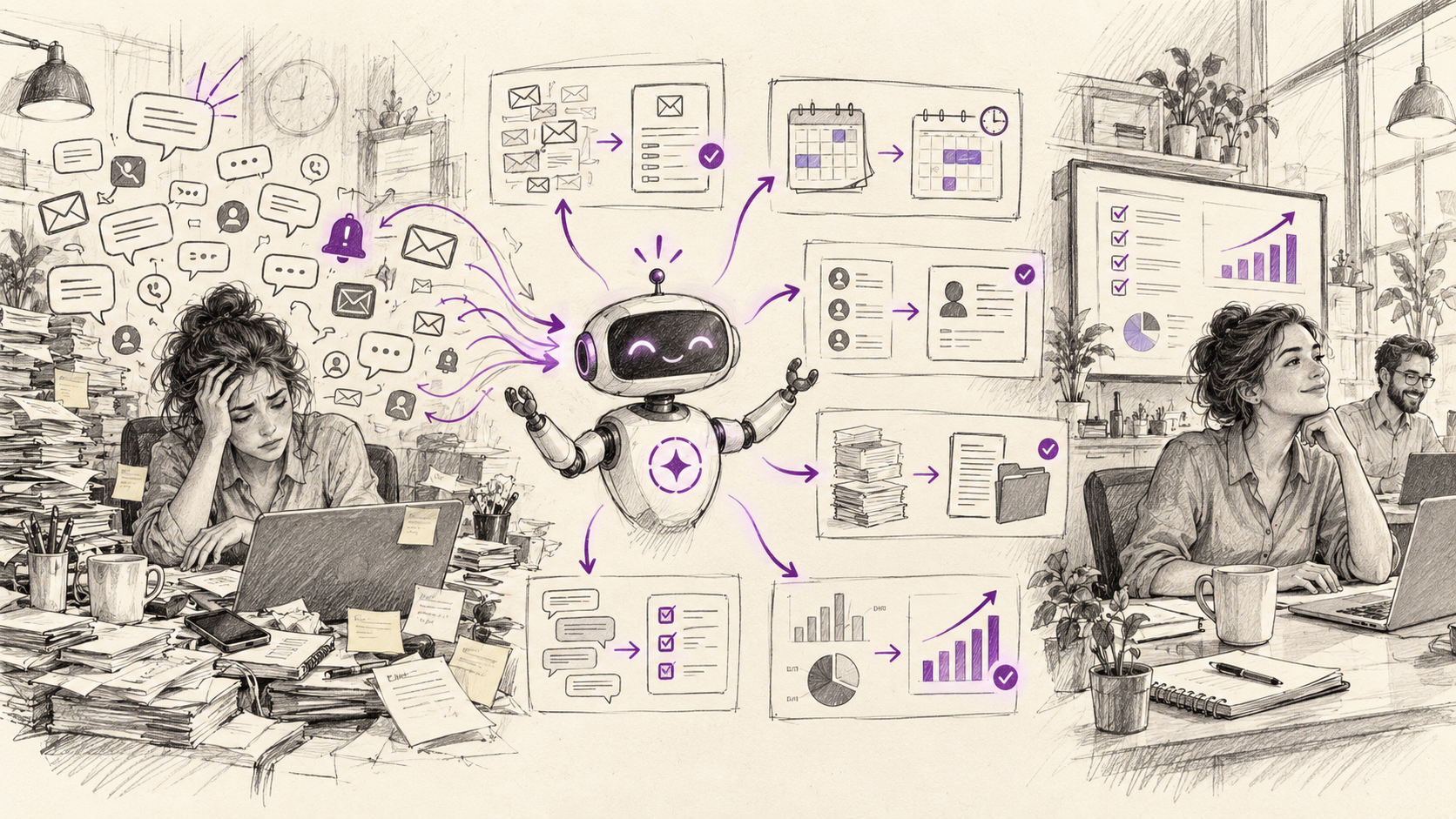
That matters because adoption has reached a clear tipping point. Recent research shows that more than half of SMBs now use some form of AI, while many others are actively exploring it. But there is still a gap between using AI tools and getting measurable business value from them. Many teams are testing chatbots, content tools, or assistants in isolated ways without tying those efforts to time saved, cost reduction, service improvements, or revenue growth.
That is where many businesses get stuck.
The companies seeing the best AI automation ROI for small business are not chasing every new tool. They are choosing one valuable workflow, setting a baseline, and tracking outcomes from day one.
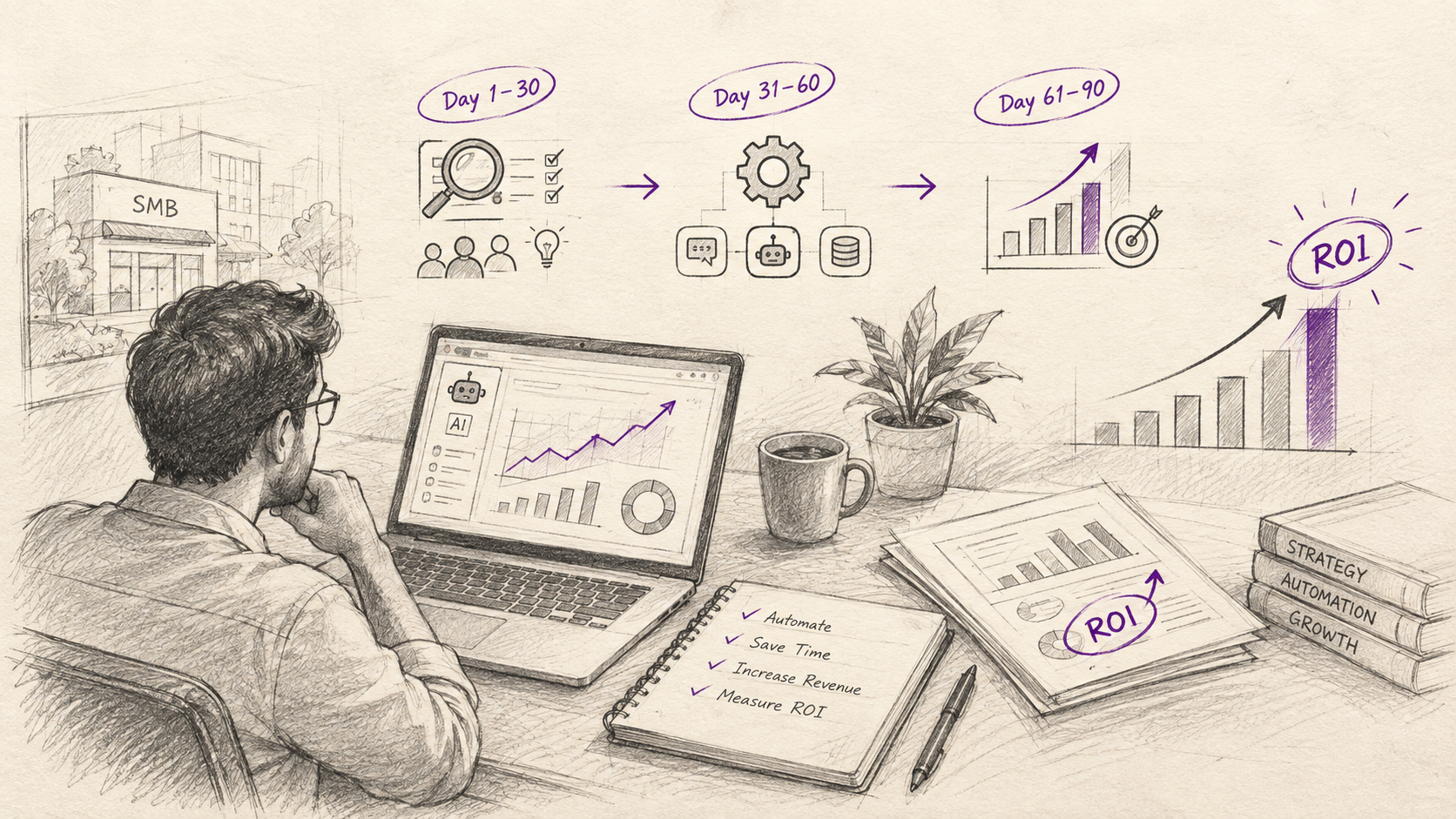
Here is how to do that in a practical 90-day window.
Why so many SMBs are still stuck in pilot mode
AI adoption is growing fast, but most businesses are still early in their journey. Some surveys show 40% to 52% of U.S. SMBs already using AI, while broader market data suggests over 75% are either using or exploring it. That is a strong signal that AI is becoming part of normal business operations.
Still, adoption alone does not equal return.
Many AI pilots stall because businesses:
- start with tools instead of business problems
- automate messy or inconsistent processes
- fail to define success metrics upfront
- underestimate data and integration issues
- do not train teams on the new workflow
In other words, they experiment without a plan.
If you want measurable AI productivity gains for small business, the goal is not to “use AI more.” The goal is to improve a specific business process in a way that shows up in your numbers.
Where AI delivers fast, measurable ROI
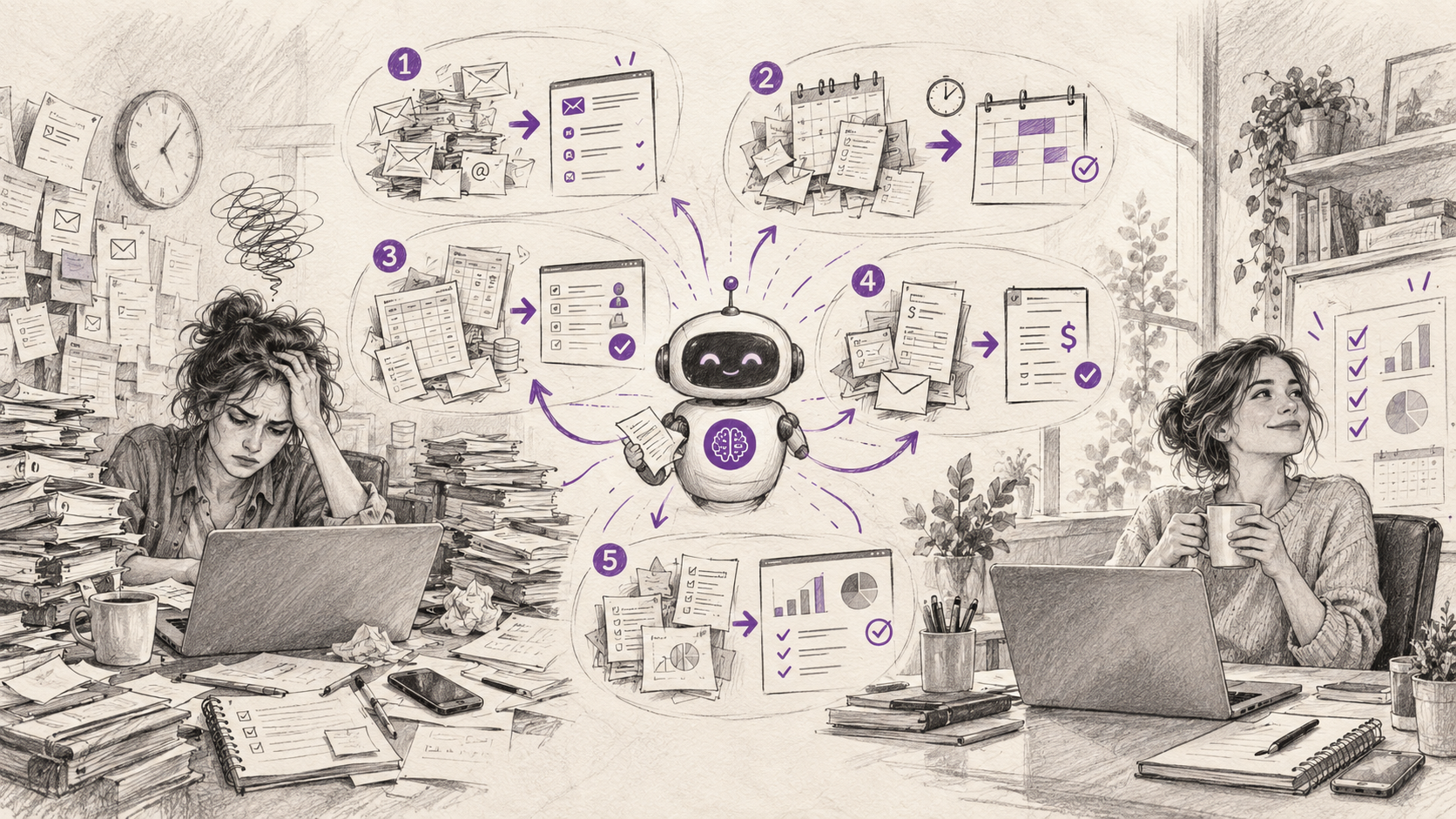
The strongest early wins usually come from high-volume, repeatable work that depends on rules, templates, or simple decisions. These are the areas where AI and automation can reduce manual effort quickly.
Common high-ROI use cases include:
Customer service automation
This is one of the fastest paths to AI customer service automation ROI. AI agents can handle routine inquiries, route tickets, answer common questions, and provide 24/7 first-line support.
Business impact often includes:
- lower ticket volume for human teams
- faster response times
- improved customer experience
- reduced after-hours staffing pressure
Lead follow-up and appointment booking
Missed follow-up is lost revenue. AI agents can qualify inquiries, send immediate responses, answer common sales questions, and book meetings automatically.
That can lead to:
- faster speed-to-lead
- higher conversion rates
- less admin work for sales teams
- more consistent pipeline coverage
Back-office workflow automation
This is often where the biggest hidden savings live. Think invoice processing, CRM updates, billing sync, reporting, order management, and reconciliation between systems.
One documented example showed an operations team cutting manual data entry by 85%, saving $180,000 in labor, and generating 718% year-one ROI after connecting CRM, billing, and project systems with AI-supported automation.
Internal reporting and knowledge work
AI can summarize meetings, draft reports, surface key data points, and reduce time spent searching across documents and systems. Even modest time savings matter. Microsoft has reported that users who save as little as 11 minutes per day quickly perceive strong value, and many users report clear productivity gains over a business quarter.
That is the point: ROI does not always require a massive transformation. Sometimes it starts with recovering minutes each day that compound into hours each week.
Research across SMB case studies suggests many projects achieve first-year ROI in the 200% to 400% range, with payback often in 3 to 6 months. That makes AI workflow automation for mid-market companies especially attractive when leaders are focused on efficiency and margin improvement.
How to measure AI ROI in SMBs with a simple scorecard
If you are wondering how to measure AI ROI in SMBs, keep it simple. You do not need a complicated analytics stack. You need a baseline, a small set of business metrics, and a clear formula.
Start with these core metrics
Track the metrics most directly tied to business value:
- Hours saved per week or month
- Labor cost avoided from reduced manual work
- Revenue uplift from faster follow-up, higher conversion, or increased capacity
- Error reduction that lowers rework, write-offs, or service issues
- Cycle time reduction for quotes, invoices, tickets, or onboarding
- Customer outcomes such as response times, satisfaction, or retention
Establish a baseline before automation
Before deployment, capture the current state:
- How many hours does the workflow take today?
- How many people touch it?
- How often do delays or errors happen?
- What is the cost of those delays?
- Does the workflow affect revenue, retention, or service levels?
Without a baseline, it is almost impossible to prove ROI.
Use a simple ROI formula
A practical AI ROI scorecard for business owners can use this formula:
ROI = (Net Benefits / Total Costs) x 100
Where:
- Net Benefits = labor savings + revenue gains + error reduction savings
- Total Costs = software, implementation, integration, training, and support
For example, if an AI automation saves 15 hours per week, reduces rework, and helps your team handle more customer demand without hiring, the financial benefit becomes easier to calculate than most leaders expect.
This is also why strong implementation matters. Broader market guidance shows businesses often see roughly $3.5 to $3.7 returned for every $1 invested in AI automation when projects are tied to real workflows and measured properly.
A 90-day AI implementation roadmap for small businesses
A useful AI implementation roadmap for small businesses should be focused, realistic, and measurable.
Weeks 1-2: Choose one workflow that matters
Pick a process that is:
- high volume
- repetitive
- currently manual
- painful for staff or customers
- easy to measure
Good examples include lead response, invoice handling, customer support triage, appointment scheduling, or CRM data updates.
Before automating, fix obvious process problems first. Automating a broken workflow usually creates faster confusion, not better results.
Weeks 3-6: Design and deploy a focused solution
This is where you implement a practical AI agent or automation around the chosen workflow.
Key priorities should include:
- clear inputs and outputs
- defined exception handling
- access and permission controls
- integration with current tools
- tracking for time, cost, and outcome metrics
Keep scope tight. One workflow done well is more valuable than five partial experiments.
Weeks 7-12: Measure, improve, and expand
Review actual performance against your baseline:
- Are hours being saved?
- Are service levels improving?
- Are errors declining?
- Is the team using the new workflow consistently?
- Is there a measurable business case to expand?
Use those findings to refine the process, improve adoption, and identify the next adjacent workflow. This is how a single pilot becomes repeatable ROI across departments.
What leaders must address to avoid stalled projects
For SMBs and mid-market firms, the biggest barriers are usually not technical complexity alone. They are execution issues.
Common risks include:
- poor data quality
- disconnected systems
- unclear ownership
- low team adoption
- unrealistic expectations
The practical way forward is to start with low-risk, high-value use cases and tie them directly to P&L goals. Look for opportunities to save hours, increase throughput, reduce service delays, or avoid unnecessary hiring.
It is also important to set realistic expectations. AI value often starts with small gains: 30 minutes saved here, two hours saved there, fewer errors, faster responses, better consistency. Across a quarter, those gains add up. Across multiple workflows, they become material.
This is where the right implementation partner can make the difference. A structured approach to workflow design, system integration, governance, and training helps businesses move from isolated pilots to durable business outcomes.
Conclusion
The opportunity is clear. AI adoption is accelerating, and the businesses that win will not be the ones that test the most tools. They will be the ones that connect AI to real workflows, real metrics, and real outcomes.
If you want stronger AI automation ROI for small business, start with one process, build a simple scorecard, and work toward measurable gains in the next 90 days.
That is exactly where Axyva helps. We work with SMBs and mid-market teams to identify the right use cases, design practical AI agents and intelligent automations, and deploy solutions that deliver measurable business value. If you are ready to move from experimentation to execution, it may be time to explore what that could look like for your business.