Businesses have access to more data than ever before. Sales platforms, marketing tools, accounting systems, customer support software, operational systems, and countless other applications generate valuable information every day.
To make sense of this data, organizations invest in dashboards.
The goal is simple: provide decision-makers with clear visibility into performance, trends, and opportunities.
Yet despite significant investments in reporting and analytics, many dashboards fail to deliver meaningful business value.
Some are rarely used. Others overwhelm users with excessive information. Many become static reporting tools rather than decision-support systems.
The problem is not the dashboard itself. The problem is often how the dashboard is designed.
Understanding why dashboards fail is the first step toward building ones that actually improve business performance.
The dashboard is not the goal
One of the most common mistakes businesses make is treating the dashboard as the final objective.
A dashboard is simply a tool.
The real objective is better decision-making.
When organizations focus exclusively on visualizing data without considering how that information will be used, the result is often a dashboard filled with charts that look impressive but provide little practical value.
Before building any dashboard, businesses should ask:
- What decisions will this dashboard support?
- Who will use it?
- What actions should users take based on the information?
- Which metrics truly matter?
Answering these questions helps establish a clear purpose for the dashboard.
Too much information
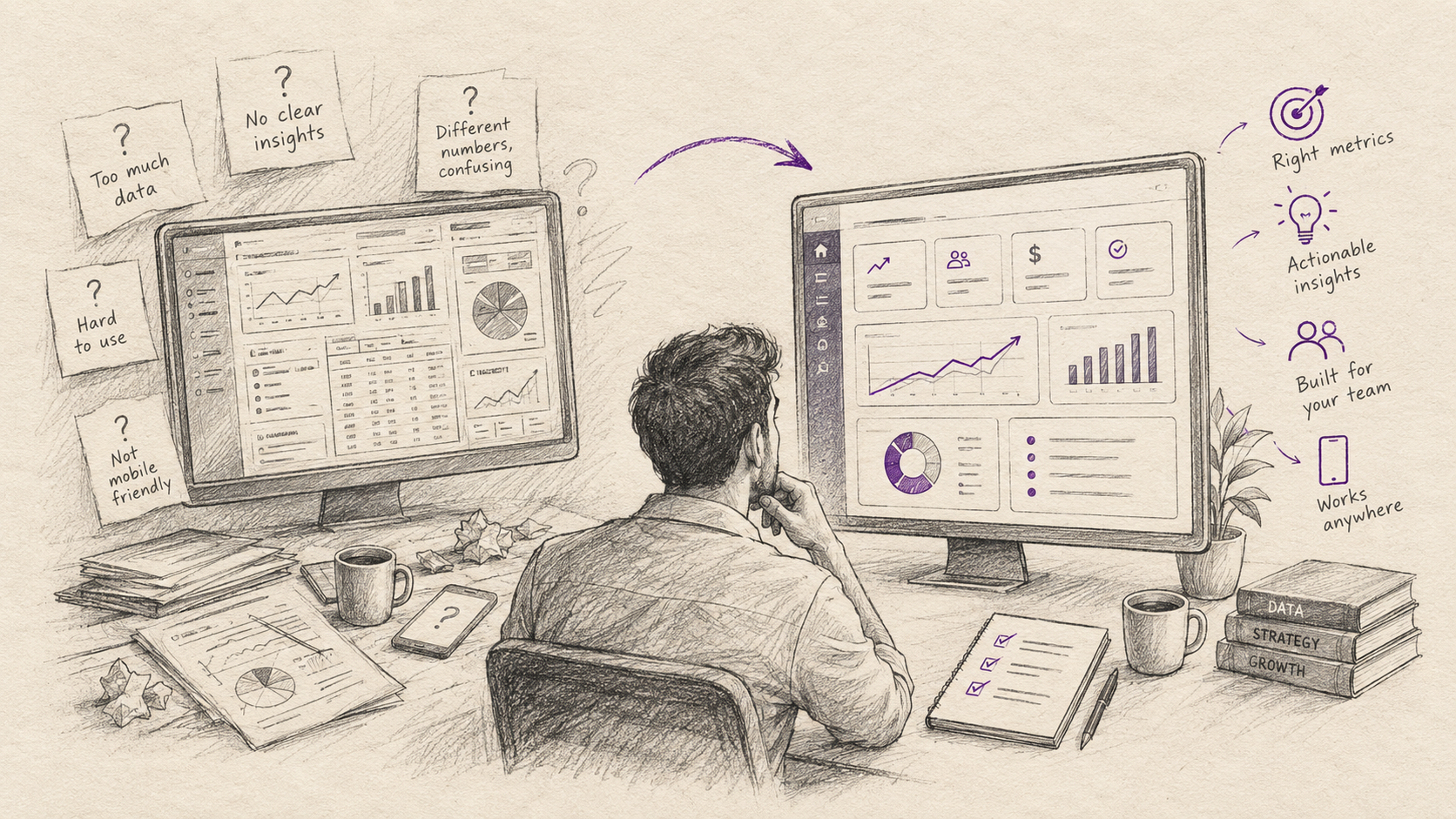
Many dashboards fail because they attempt to display everything.
Business leaders often request every available metric, report, and chart in an effort to provide complete visibility.
The result is information overload.
Users struggle to identify what matters most because important insights become buried among dozens of metrics.
Effective dashboards focus on the metrics that directly support decision-making.
In many cases, fewer metrics create more value.
A dashboard should prioritize clarity over completeness.
Metrics without context
A number by itself rarely tells a meaningful story.
For example, a sales figure may appear impressive, but without historical comparisons, targets, or trends, it becomes difficult to interpret.
Context transforms data into insights.
Effective dashboards help users understand:
- Performance against targets
- Historical trends
- Growth or decline over time
- Comparisons across departments or locations
- Emerging opportunities or risks
Without context, users are left to draw their own conclusions, which often leads to inconsistent decision-making.
Different users need different dashboards
Another common mistake is creating a single dashboard for everyone.
Executives, managers, sales teams, marketing departments, operations leaders, and finance teams all require different information.
A CEO may want high-level business performance indicators.
A sales manager may need pipeline visibility.
An operations team may focus on efficiency and productivity metrics.
Trying to satisfy every audience with a single dashboard often results in a solution that serves no one particularly well.
Effective business intelligence initiatives recognize that different stakeholders require different perspectives.
Poor data quality
Even the most visually appealing dashboard will fail if the underlying data is unreliable.
Many organizations struggle with:
- Inconsistent data sources
- Duplicate records
- Missing information
- Manual reporting processes
- Disconnected systems
When users lose confidence in the accuracy of dashboard data, adoption declines quickly.
Trust is essential.
Successful dashboards rely on strong data management practices and reliable data sources.
Organizations should prioritize data quality before investing heavily in visualization.
Static reporting creates limited value
Traditional reports often provide a snapshot of what happened in the past.
While historical information is valuable, modern organizations require more than static reporting.
Business leaders need the ability to:
- Explore data
- Identify trends
- Investigate anomalies
- Monitor performance in real time
- Answer business questions quickly
Interactive dashboards create significantly more value than reports that simply display information.
The best dashboards encourage exploration and discovery.
Lack of business alignment
Technology teams sometimes build dashboards based on available data rather than business objectives.
As a result, dashboards may measure activity rather than outcomes.
For example, a marketing dashboard may focus heavily on website traffic while ignoring lead quality and revenue impact.
An operations dashboard may track task volume while overlooking efficiency improvements.
Effective dashboards align metrics with business goals.
Every KPI should have a clear connection to organizational performance.
If a metric does not support a decision or business objective, it may not belong on the dashboard.
What effective dashboards have in common
Successful dashboards tend to share several characteristics.
Clear purpose
Every dashboard is designed to support specific business decisions.
Relevant KPIs
Metrics focus on outcomes rather than vanity measurements.
Audience-specific design
Information is tailored to the needs of specific users.
Reliable data
Users trust the information presented.
Actionable insights
The dashboard helps users determine what action to take next.
Simplicity
Information is easy to understand and interpret.
These principles create dashboards that become valuable operational tools rather than unused reporting assets.
Building dashboards that drive decisions
Organizations should approach dashboard development as a business initiative rather than a reporting project.
The process typically involves:
- Defining business objectives
- Identifying stakeholders
- Selecting meaningful KPIs
- Integrating data sources
- Designing user-focused visualizations
- Testing and refining based on feedback
The goal is not to display more information.
The goal is to help people make better decisions faster.
When dashboards are designed with this mindset, adoption and business value increase significantly.
The role of business intelligence
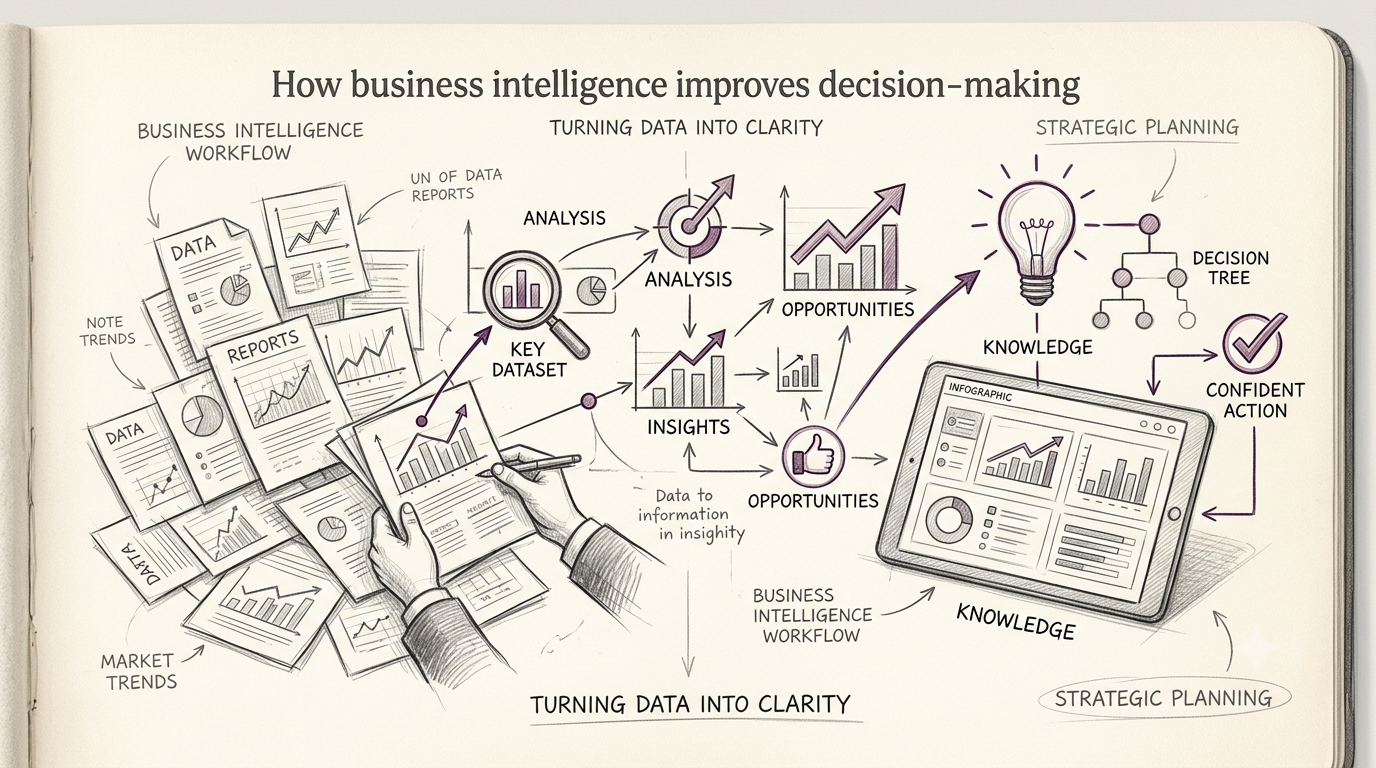
A dashboard is only one component of a broader business intelligence strategy.
True business intelligence combines data collection, integration, analysis, visualization, and decision support.
Organizations that view dashboards as part of a larger analytics ecosystem are often better positioned to generate value from their data.
Rather than simply reporting what happened, they gain the ability to understand why it happened and what should happen next.
Final thoughts
Dashboards fail when they focus on visualizing data rather than supporting decisions.
Too much information, poor data quality, lack of context, and weak alignment with business objectives can all limit their effectiveness.
The most successful dashboards are designed around business goals, user needs, and actionable insights. They simplify complexity, improve visibility, and help organizations make more informed decisions.
At Axyva, we help businesses design business intelligence solutions that go beyond reporting. By combining data strategy, analytics, dashboard development, and decision-support frameworks, we help organizations transform information into meaningful business outcomes.
A great dashboard does not simply display data. It helps drive better decisions.