2026 AI ROI Playbook for SMBs and Mid-Market
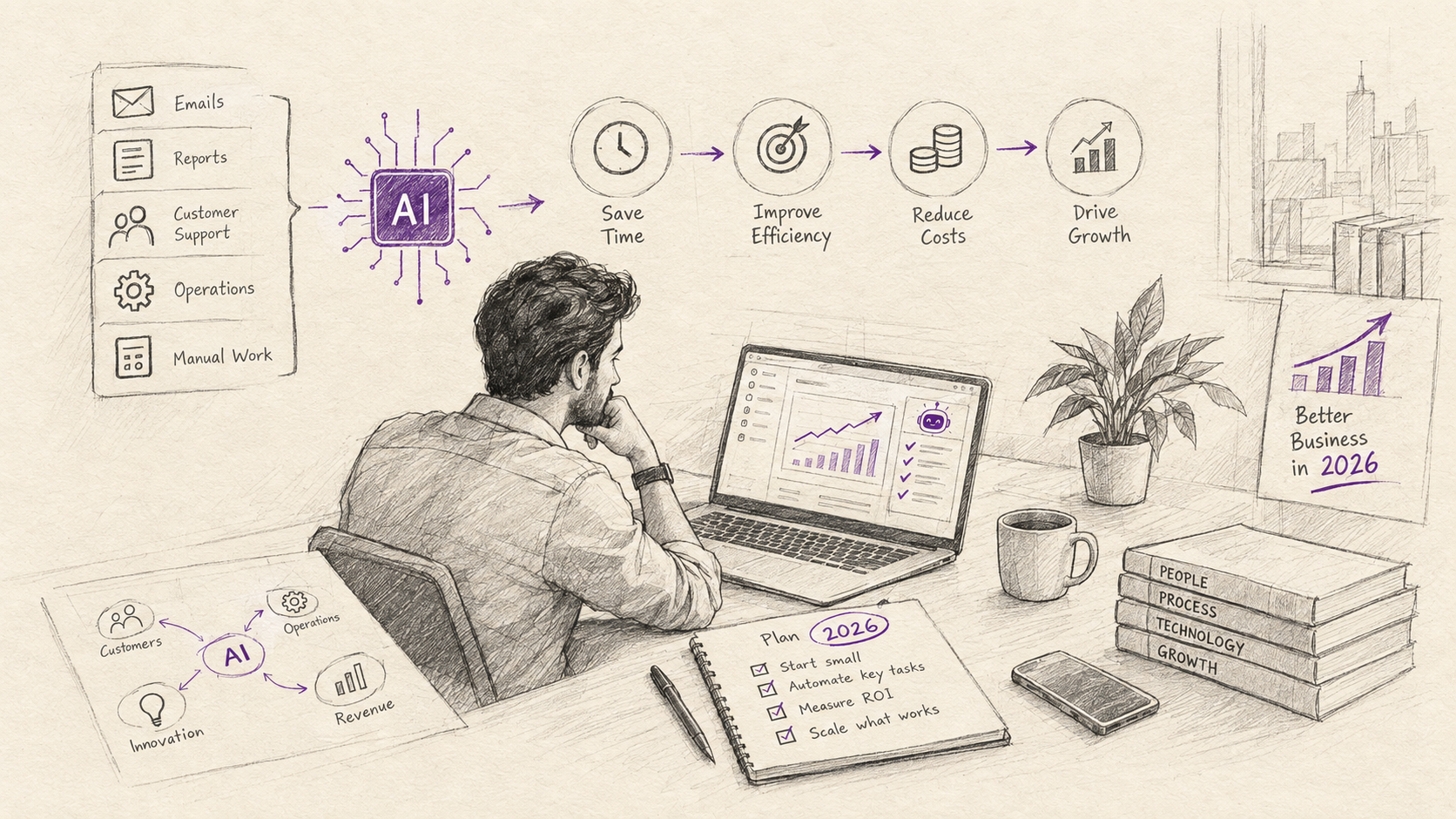
AI is no longer a side experiment for growing businesses. In 2026, the real question is not whether to use AI. It is where to use it first so it pays for itself quickly.
For SMBs and mid-market companies, that matters because budgets are tighter, teams are leaner, and every new investment needs a clear business case. Leaders are under pressure to improve productivity, reduce manual work, and protect margins—without adding unnecessary complexity.
That is why AI automation ROI for small business has become such an important topic. The companies seeing results are not trying to automate everything at once. They are choosing a few high-friction workflows, measuring the savings, and scaling from there.
This playbook explains where to start, how to think about AI budget for SMBs 2026, and how to build a simple model for a 6–12 month payback.
Why 2026 is the year AI must prove ROI
AI adoption has moved fast. Most SMBs are now either using AI, piloting it, or actively exploring where it fits. At the same time, expectations have changed. Executives, investors, and boards are no longer satisfied with vague innovation stories. They want measurable gains in efficiency, output, and profit.
That shift is healthy.
It forces businesses to treat AI like any other operational investment:
- What process will improve?
- How many hours will it save?
- What revenue will it protect or create?
- How long until it pays back?
In practical terms, this means the best AI projects are not usually the flashiest. They are the ones that remove repetitive manual work, speed up routine decisions, and help teams do more without increasing headcount.
What to automate first for the fastest payback
The best early AI opportunities usually share three traits:
- The work is repetitive
- The process happens often
- The result can be measured clearly
For most SMBs, the fastest wins come from front-office and back-office workflows that already consume staff time every day.
High-ROI SMB workflows
If you want a short AI payback period for small business, start here:
1. Lead follow-up and qualification
Sales teams often lose revenue because leads sit too long or receive inconsistent responses. An AI agent can:
- Respond to inbound inquiries instantly
- Qualify leads based on rules
- Route prospects to the right salesperson
- Draft follow-up emails automatically
This improves speed-to-lead and helps capture revenue that would otherwise slip away.
2. Customer support triage
Many businesses spend hours answering common questions by email or chat. AI can:
- Draft responses to frequent queries
- Classify tickets by urgency
- Pull answers from internal knowledge bases
- Escalate only the cases that need a human
This is one of the clearest examples of how to measure AI productivity gains because you can track response time, ticket volume, and hours saved.
3. Invoice processing and collections
Finance teams often deal with manual data entry, invoice matching, and overdue follow-up. AI automation can:
- Extract invoice data
- Flag exceptions
- Draft payment reminders
- Trigger collection workflows
A practical example is an AI agent that chases overdue invoices and drafts collection emails automatically.
4. Scheduling and internal coordination
Administrative coordination is a hidden time drain. AI can handle:
- Meeting scheduling
- Reminder emails
- Status updates
- Routine internal requests
The time savings may look small per task, but the volume adds up quickly.
5. Reporting and document cleanup
Many teams still spend hours each week summarizing updates, cleaning spreadsheets, or turning raw notes into usable reports. AI is well suited for:
- Summarizing meeting notes
- Drafting weekly reports
- Standardizing documents
- Cleaning and categorizing business data
Mid-market AI automation use cases with strong upside
For larger teams and more complex operations, the most valuable mid-market AI automation use cases often sit inside core business functions:
- Faster month-end close in finance
- Contract summarization and risk review
- Procurement document processing
- HR onboarding and policy support
- AI-assisted service desk workflows
- Internal knowledge search across systems
These use cases often touch multiple teams, which means the ROI can be bigger—but so can the implementation complexity. That is where a structured rollout matters.
A simple AI ROI calculator for small business leaders
You do not need a technical background to estimate whether an automation project makes sense. A simple AI ROI calculator for small business can be built with five steps.
Step 1: Define one specific workflow
Be narrow. Do not start with “customer service” or “finance.” Start with a single process like:
- Answering common support emails
- Processing incoming invoices
- Following up on new leads
Step 2: Calculate the current manual cost
Estimate:
- Hours spent per week
- Fully loaded hourly cost of the employee or team
- Error, delay, or missed-revenue impact if relevant
For example:
- 25 hours per week spent on support email triage
- Staff cost of $30 per hour
- Annual labor cost = 25 × $30 × 52 = $39,000
Step 3: Estimate realistic efficiency gains
Do not assume perfection. For many workflows, a realistic starting estimate is:
- 30–50% time savings for assisted workflows
- Higher savings for highly repetitive tasks
If AI reduces the support workload by 40%, annual savings would be:
- $39,000 × 40% = $15,600
Step 4: Include total first-year costs
This should include more than the monthly software fee:
- Tool or platform cost
- Setup and integration
- Process design
- Training and change management
- Ongoing support if needed
Example:
- AI software: $400/month = $4,800/year
- Setup and implementation: $6,000
- Total first-year cost: $10,800
Step 5: Calculate payback period and ROI
Using the example above:
- Annual savings: $15,600
- First-year cost: $10,800
- Net first-year gain: $4,800
Monthly savings are about $1,300. That means the payback period is roughly:
- $10,800 ÷ $1,300 = 8.3 months
That is a strong result for an initial AI project. If a workflow is tied directly to revenue capture—such as lead follow-up—the payback can be even faster.
AI budget for SMBs 2026: how much should you invest?
A practical AI budget for SMBs 2026 should reflect your size, operational maturity, and urgency—not market hype.
A useful starting point is:
- Allocate roughly 1–3% of revenue to technology overall
- Dedicate 20–30% of that technology budget to AI exploration and deployment
That does not mean spending big immediately. It means setting aside enough budget to test meaningful opportunities properly.
Typical investment tiers
Off-the-shelf tools: $50–$500 per month
Best for simple productivity gains, individual teams, or basic copilots. These tools can help quickly, but they are often limited when workflows span multiple systems.
Custom workflow automation: $5,000–$30,000+
Best when you need AI to work inside your real business process, connect with your systems, and produce measurable operational outcomes.
Broader AI programs: higher strategic budgets
These are better suited for businesses ready to scale across departments with governance, integration, and performance tracking in place.
The right choice depends on what you are solving. Many businesses waste money by buying tools first and looking for use cases later. A better approach is to identify the process, define the result, and choose the investment level that fits the outcome.
How to measure AI productivity gains without overcomplicating it
If you want confidence in AI ROI, keep measurement simple. Focus on a few business metrics tied directly to the workflow.
Track metrics such as:
- Hours saved per week
- Turnaround time
- Output per employee
- Error rates
- Cost per transaction
- Lead response time
- Conversion rate
- Days sales outstanding for collections
This is the clearest answer to how to measure AI productivity gains: compare before and after performance on one workflow, over a defined period, using business metrics your leadership team already trusts.
From one workflow to a scalable AI roadmap
The businesses getting the strongest returns are not chasing disconnected tools. They are following a staged rollout:
1. Start with one or two high-ROI workflows
Choose processes with visible friction and measurable impact.
2. Prove the economics
Track savings, speed improvements, and quality gains for 60–90 days.
3. Standardize and expand
Once the first use case works, move into adjacent workflows in finance, operations, sales, or service.
4. Add AI agents where multi-step work exists
This is where AI becomes more than a chatbot. An AI agent can coordinate actions across systems, trigger next steps, and keep work moving with less manual oversight.
5. Build governance as you scale
As adoption grows, focus on data quality, permissions, process ownership, and accountability.
Common challenges—poor process definition, messy data, weak integration, and lack of internal capacity—are exactly why many businesses benefit from an experienced implementation partner.
Conclusion
AI can absolutely deliver fast, measurable returns for SMBs and mid-market businesses—but only when it is applied with discipline.
The strongest results usually come from automating the workflows that are repetitive, frequent, and easy to measure. Start with a clear process. Build a simple ROI model. Aim for a realistic AI payback period for small business of 6–12 months. Then scale based on evidence, not assumptions.
That is where Axyva can help. We work with businesses to identify high-value opportunities, design practical AI agents and intelligent automations, and implement solutions that deliver real operational and financial impact.
If you are exploring where AI can create measurable value in your business, Axyva can help you build the right roadmap—and avoid costly trial and error.